Exploring Bonus Opportunities at Spin Galaxy for New Zealand Players
Online casino enthusiasts in New Zealand are constantly searching for valuable promotions to enhance their gaming experience, with no deposit bonuses being among the most sought-after offers. These bonuses provide a risk-free opportunity to explore a casino’s game library and potentially win real money without committing any personal funds. For players investigating the offerings at Spin Galaxy spin-galaxy.co.nz, understanding the full spectrum of available promotions is key. While a specific no deposit bonus may not always be on the table, this platform ensures that Kiwi players have access to a stellar range of alternative rewards, starting with a substantial welcome package.
Spin Galaxy has established itself as a premier destination for New Zealand players, focusing on delivering a high-quality gaming environment, a vast selection of pokies and table games, and a secure platform. The casino’s promotional strategy is designed to reward both new and loyal players, ensuring that everyone has a chance to boost their bankroll. Instead of focusing solely on one type of bonus, the operator provides a multi-layered welcome offer, ongoing promotions, and a comprehensive loyalty program, creating a more sustained and rewarding journey for its members.
The Generous Spin Galaxy Welcome Package
For new players from New Zealand, Spin Galaxy rolls out an impressive welcome package distributed across the first three deposits. This structure allows players to extend their initial gaming sessions and explore the extensive game catalogue with a significantly larger balance. The total package can award up to NZ$1,500 in bonus funds plus 180 free spins, making it one of the more competitive offers in the NZ market. The minimum deposit to qualify for each stage of this bonus is a mere NZ$5, which makes it highly accessible for all types of players.
The welcome bonus is broken down as follows:
Deposit
Bonus Match
Maximum Bonus
Free Spins
First
100%
Up to NZ$500
50 Free Spins
Second
50%
Up to NZ$500
60 Free Spins
Third
50%
Up to NZ$500
70 Free Spins
This tiered approach ensures that the rewards keep coming, providing excellent value long after the initial sign-up. The free spins included in the package are typically for popular pokie games, giving players a chance to spin the reels on top titles without using their deposited funds.
Understanding Bonus Terms and Wagering Requirements
Before claiming any casino offer, it is crucial to understand the associated terms and conditions. At Spin Galaxy, the bonus funds from the welcome package are subject to a 35x wagering requirement. This is a standard industry practice, meaning players must wager the bonus amount 35 times before they can withdraw any associated winnings. For example, if a player receives a NZ$100 bonus, they would need to place bets totalling NZ$3,500 to fulfil the requirement.
It’s also important to note game contribution rates. This refers to how much different game types contribute towards meeting the wagering requirements. Here is a general breakdown:
Pokies (excluding NetEnt games and progressive jackpots): 100%
NetEnt Pokies: 50%
Table Games (like Roulette and Blackjack): 8%
Progressive Jackpots, Baccarat, Craps: 0%
These contribution rates mean that playing pokies is the most efficient way to clear the bonus. Players should always review the specific terms on the Spin Galaxy website for the most up-to-date information, as these details can sometimes change.
Ongoing Promotions and the Loyalty Programme
The rewards at Spin Galaxy extend far beyond the initial welcome offer. The casino is committed to keeping its existing players engaged with a variety of ongoing promotions. These can include daily and weekly reload bonuses, free spin offers, and special tournaments. Players are encouraged to check the promotions page regularly and opt-in to email communications to stay informed about the latest deals.
Furthermore, Spin Galaxy features a rewarding multi-tiered loyalty programme. From the moment a player makes their first deposit, they begin earning loyalty points for every cash wager placed. These points can be accumulated and later exchanged for bonus credits, providing a continuous stream of value. The more you play, the higher you climb through the loyalty levels, unlocking even greater benefits.
The loyalty programme consists of several levels, each offering progressively better perks.
Loyalty Level
Potential Benefits
Bronze
Entry-level point accumulation
Silver
Faster point earning
Gold
Exclusive bonus offers
Platinum
Personalised gifts and support
Diamond
Higher withdrawal limits
Privé
VIP host and bespoke rewards
Gaming and Software Providers
A great bonus is only as good as the games you can use it on, and Spin Galaxy excels in this area. The casino boasts a library of over 4,000 titles from some of the world’s most renowned software developers. This ensures a diverse and high-quality gaming experience for all Kiwi players.
Here are some of the leading providers powering Spin Galaxy:
Microgaming: A pioneer in the industry, known for iconic progressive jackpots like Mega Moolah and classic pokies such as Immortal Romance.
NetEnt: Famous for visually stunning and innovative games like Starburst and Gonzo’s Quest.
Evolution Gaming: The undisputed leader in live casino games, offering immersive live dealer versions of Blackjack, Roulette, Baccarat, and popular game shows.
The game selection is neatly categorised, allowing players to easily find their favourites. Whether you prefer spinning the reels of the latest video pokies, testing your strategy at the blackjack table, or enjoying the authentic atmosphere of the live casino, Spin Galaxy has something to offer.
Banking Methods for New Zealand Players
Spin Galaxy provides a convenient and secure banking experience tailored for the New Zealand market. All transactions can be conducted in New Zealand Dollars (NZD), eliminating any concerns about currency conversion fees. The casino supports a range of popular and trusted payment methods for both deposits and withdrawals.
The platform uses advanced SSL encryption technology to protect all financial data, ensuring that players’ personal and banking information remains confidential and secure. This commitment to security allows players to deposit and withdraw funds with complete peace of mind.
Payment Method
Type
Availability
Visa
Credit/Debit Card
Deposit & Withdrawal
MasterCard
Credit/Debit Card
Deposit & Withdrawal
Skrill
E-Wallet
Deposit & Withdrawal
Neteller
E-Wallet
Deposit & Withdrawal
Jeton
E-Wallet
Deposit & Withdrawal
Flexepin
Prepaid Voucher
Deposit Only
Withdrawal times are competitive, with e-wallet transactions typically processed within 24 hours, while card payments may take 1-3 business days. This efficiency ensures that players can access their winnings promptly.
Is a no deposit bonus currently available at Spin Galaxy for NZ players?
Currently, Spin Galaxy focuses on its comprehensive three-part welcome package of up to NZ$1,500 and 180 free spins instead of a standard no deposit bonus. It is always recommended to check their promotions page for any new or exclusive offers that may become available.
What is the minimum deposit to claim the welcome bonus?
The welcome bonus at Spin Galaxy is very accessible, requiring a minimum deposit of just NZ$5 for each of the first three deposit offers. This allows players with all budget sizes to take advantage of the promotion.
What are the wagering requirements for bonuses?
The standard wagering requirement for the welcome bonus funds at Spin Galaxy is 35x. This means the bonus amount must be wagered 35 times before winnings can be converted to cash and withdrawn.
Can I use New Zealand Dollars (NZD) at Spin Galaxy?
Yes, Spin Galaxy is fully optimised for the New Zealand market. Players can deposit, play, and withdraw using NZD, which avoids any currency conversion fees and simplifies the banking process.
https://www.lemonaide.com.au/wp-content/uploads/2024/06/Lemonaide-Logo.png00Bonnie Louisehttps://www.lemonaide.com.au/wp-content/uploads/2024/06/Lemonaide-Logo.pngBonnie Louise2026-07-14 16:25:122026-07-14 16:25:16Spin Galaxy No Deposit Bonus Availability For NZ Players
Unlocking Free Spin Opportunities at Neon54 Casino in Australia
For Australian online gaming enthusiasts, finding a platform that combines a vast game library with generous promotional offers is the ultimate goal. Neon54 Casino https://neon-54.casino has emerged as a prominent destination, particularly for players who enjoy spinning the reels of online pokies. The allure of free spins is undeniable, as they provide an opportunity to explore new games and secure potential winnings without risking additional funds. Neon54 Casino has integrated a variety of free spin bonuses into its promotional structure, catering to both new and existing players across Australia. These offers are designed to enhance the gaming experience from the very beginning, often bundled with welcome packages and extending into regular weekly promotions.
Understanding how to access and utilise these free spins is key to maximising their benefits. The process is typically straightforward, beginning with registration and the selection of a welcome offer. Each bonus comes with its own set of terms, including which specific pokie games are eligible for the free spins. This allows players to dive into some of the most popular and exciting titles available on the platform. From high-volatility adventures to classic fruit machines, the qualifying slots often represent a diverse cross-section of the casino’s extensive portfolio, ensuring that there is something to suit every player’s preference. The following sections will provide a detailed guide on how to claim these offers, which games you can play, and the important conditions to keep in mind.
How to Claim and Activate Your Free Spins
Getting started with free spins at Neon54 Casino is a streamlined process designed for user convenience. The journey begins with creating an account, which is a quick and secure procedure. Once registered, players from Australia can navigate to the promotions section to view all available offers. The most common way to receive free spins is through a deposit bonus, particularly the welcome offer. Players simply need to make a qualifying deposit, and the free spins are automatically credited to their account, ready for use on designated games. It’s crucial to check the minimum deposit amount required to activate a specific bonus.
For players in Australia, here is a simple step-by-step guide to claiming your free spins:
Create an Account: Visit the Neon54 Casino website and complete the registration form with your details.
Choose a Welcome Bonus: During the sign-up process or on your first deposit, you’ll be prompted to select one of the available welcome packages, many of which include free spins.
Make a Qualifying Deposit: Head to the cashier and deposit the minimum required amount using one of the many available payment methods suitable for AUD transactions.
Receive Your Spins: The free spins will be credited to your account. In most cases, this happens instantly after the deposit is confirmed.
Find the Qualifying Game: Open the pokie game specified in the bonus terms and conditions. Your free spins will be waiting for you to start playing.
Check for Other Promotions: Regularly visit the “Promotions” page for ongoing offers like weekly reloads or special events that may grant additional free spins.
By following these steps, players can seamlessly integrate free spin bonuses into their gaming sessions, extending their playtime and increasing their chances of hitting a significant win. Always remember to opt-in for promotional emails to stay informed about exclusive and limited-time free spin offers.
Welcome Bonuses and Introductory Free Spins
Neon54 Casino distinguishes itself with a unique approach to welcome bonuses, allowing new players to choose from one of five different “star” avatars, each representing a distinct welcome package. Several of these packages include a substantial number of free spins alongside a deposit match, giving players a fantastic head start. For instance, the Kriss welcome bonus is particularly appealing to pokie lovers, offering up to 200 free spins distributed over ten days. This structure encourages players to return and explore the platform daily.
The table below outlines some of the welcome offers that typically feature free spins, providing a clear comparison for new Australian players.
Welcome Offer Avatar
Bonus Details
Free Spins Included
Kriss
Up to $1,500 in 3 bonuses + 1 Bonus Crab
Up to 200 Free Spins
David Bowle
50% up to $1,500 + 1 Bonus Crab
Frequently includes spins in promotional cycles
SpoonDog
10% Cashback up to $300 + 1 Bonus Crab
Spins may be offered as part of cashback rewards
These initial offers are a great way to get acquainted with the casino’s pokie library. The free spins are often tied to some of the most popular games from leading software providers, ensuring a high-quality gaming experience right from the start. Players should carefully read the terms of their chosen welcome bonus to understand the distribution schedule of the free spins and the wagering requirements attached to any winnings.
Ongoing Promotions for Regular Players
The opportunities for free spins at Neon54 Casino don’t end with the welcome bonus. The platform is committed to rewarding its loyal Australian players with a variety of ongoing promotions. These regular offers ensure that there is always something extra to look forward to. One of the standout promotions is the Weekly Reload, which grants players 50 free spins for making a qualifying deposit during the week. This is an excellent way to boost your balance and enjoy more time on your favourite pokies.
Furthermore, the casino often runs seasonal or special event promotions that can include free spins, bonus cash, or entry into tournaments. It’s beneficial for players to keep an eye on the promotions page and their email inbox for these limited-time offers. The VIP program also plays a significant role, as players who climb the loyalty ladder can unlock more exclusive rewards, including personalised free spin packages with more favourable terms.
Here is a summary of recurring promotions that often feature free spins:
Weekly Reload: Claim 50 Free Spins every week by making a qualifying deposit between Monday and Thursday.
Weekend Reload Bonus: This offer often combines a deposit match with a bundle of free spins to make weekends more exciting.
VIP Program Rewards: As you progress through the five VIP levels, you can gain access to higher withdrawal limits, cashback, and exclusive free spin promotions from a personal account manager.
These consistent promotions demonstrate Neon54 Casino’s dedication to player satisfaction and provide continuous value long after the initial sign-up phase.
Which Pokies Qualify for Neon54 Casino Free Spins?
A crucial aspect of any free spin offer is knowing which games you can play. At Neon54 Casino, the free spins are typically designated for specific online pokies, often highlighting new releases or fan favourites from top-tier software developers. While the exact qualifying game for promotions like the Weekly Reload can change, it is always a popular title, ensuring players have a high-quality experience. The casino partners with dozens of renowned providers, including Pragmatic Play, Play’n GO, NetEnt, and Microgaming, so the selection is consistently excellent.
Players can find out which pokie is eligible by checking the terms and conditions of the specific promotion. The welcome bonus free spins, for example, are often credited for a highly popular game, giving new users a taste of the best the casino has to offer. This strategy benefits both the player and the casino; players get to try out acclaimed titles for free, and the casino can showcase its premium game library.
The table below lists some of the top software providers at Neon54 Casino and examples of popular pokies that frequently feature in free spin promotions.
Software Provider
Popular Pokie Titles
Key Features
Pragmatic Play
Gates of Olympus, Sweet Bonanza, Wolf Gold
High volatility, Tumble feature, Multipliers
Play’n GO
Book of Dead, Reactoonz, Legacy of Dead
Expanding symbols, Cluster pays, Bonus rounds
NetEnt
Starburst, Gonzo’s Quest, Dead or Alive 2
Innovative mechanics, High RTP, Engaging graphics
Relax Gaming
Money Train 2, Temple Tumble, Iron Bank
Bonus buy features, High win potential
Understanding Free Spin Terms and Conditions
To make the most of free spin offers at Neon54 Casino, it’s essential for Australian players to understand the associated terms and conditions. These rules govern how the spins can be used and how any winnings can be withdrawn. Being aware of these conditions ensures a smooth and enjoyable gaming experience without any unexpected surprises. The most important term to consider is the wagering requirement, which dictates how many times you must play through your winnings before they can be converted into real cash.
Here is a list of key terms typically associated with free spin bonuses at Neon54 Casino:
Wagering Requirements: Winnings from free spins usually come with a wagering requirement, often around 40x. This means if you win $10, you must wager $400 before withdrawing.
Maximum Win Cap: Some promotions may have a cap on the maximum amount you can win from free spins. This limit will be clearly stated in the bonus terms.
Expiry Date: Free spins are not valid forever. They typically need to be used within a specific timeframe, such as 24 hours or 7 days, before they expire.
Eligible Games: As discussed, spins are usually restricted to one or more specific pokie games. Playing other games will not use the free spins.
Minimum Deposit: To claim deposit-related free spins, you must meet the minimum deposit requirement, which is usually around $30 AUD.
By familiarising yourself with these conditions, you can strategically use your free spins and have a clear path towards cashing out your winnings. The terms at Neon54 Casino are transparently displayed with each promotion, promoting fair play.
Term
Typical Condition at Neon54 Casino
Wagering on Winnings
40x
Bonus Expiry
10 days after activation
Free Spin Validity
Usually 24 hours to 7 days
Minimum Deposit
$30 AUD for most reload offers
Frequently Asked Questions about Neon54 Casino Free Spins
Can I get free spins at Neon54 Casino without making a deposit?
While most free spin offers at Neon54 Casino are tied to a deposit, the casino may occasionally run special no-deposit promotions or award them as part of the VIP loyalty program. It is best to check the promotions page regularly for any such offers.
What are the wagering requirements for free spin winnings?
Typically, winnings generated from free spins at Neon54 Casino are subject to a 40x wagering requirement. This means you must wager the total amount of your winnings 40 times before you can withdraw them as cash.
How long do I have to use my free spins?
The validity period for free spins can vary. For daily batches, like those in the welcome bonus, they usually expire within 24 hours. For other promotions, you may have up to 7 days to use them. Always check the specific terms of the offer.
Are free spins available for mobile players in Australia?
Yes, absolutely. The Neon54 Casino platform is fully optimised for mobile devices. Australian players can claim and use their free spins on qualifying pokies directly from their smartphone or tablet browser without any loss of quality or functionality.
https://www.lemonaide.com.au/wp-content/uploads/2024/06/Lemonaide-Logo.png00Bonnie Louisehttps://www.lemonaide.com.au/wp-content/uploads/2024/06/Lemonaide-Logo.pngBonnie Louise2026-07-14 16:23:182026-07-14 16:23:21Neon54 Casino Free Spins In Australia: Qualifying Slots And How To Claim
Exploring No Deposit Bonuses at Happy Hugo Casino for Australian Players
The world of online gaming in Australia is vibrant and competitive, with platforms constantly seeking to attract new players. One of the most sought-after promotions is the no deposit bonus, which allows users to experience real-money games without any initial financial commitment. For players interested in what Happy Hugo Casino happy-hugo.casino has to offer, understanding the availability and terms of such bonuses is crucial. These promotions serve as an excellent way to explore a casino’s game library, user interface, and overall atmosphere before deciding to deposit funds.
While no deposit bonuses are a fantastic entry point, they are often part of a broader promotional strategy. Happy Hugo Casino provides a range of offers designed to enhance the gaming experience for its Australian user base. This includes generous welcome packages, weekly free spins, and other incentives. This article delves into the specifics of no deposit bonuses at Happy Hugo, covering the essential eligibility rules, the process of claiming them, and the critical withdrawal limits and conditions that players in Australia must be aware of to maximise their potential winnings.
Understanding the Mechanics of a No Deposit Bonus
Before diving into the specifics of Happy Hugo Casino, it’s important to clarify what a no deposit bonus entails. Unlike traditional deposit bonuses that match a percentage of a player’s deposited amount, a no deposit bonus is awarded simply for registering an account. It’s a risk-free incentive that comes in several forms, each with its own advantages for the player.
There are a few common types of no deposit bonuses that Australian players might encounter. The most frequent are:
Bonus Cash: A small amount of credit (e.g., $10 or $20) is added directly to the player’s bonus balance. This cash can typically be used on a wide variety of games, including pokies and table games, giving players the freedom to explore.
Free Spins: The casino grants a set number of free spins on one or more specific online pokies. This is a popular option for pokie enthusiasts, allowing them to try out new or popular titles without wagering their own money.
Free Play: A less common variant where players receive a large amount of bonus credit and a limited time frame (e.g., one hour) to win as much as possible. Any winnings above the initial bonus amount may be converted into a smaller, standard bonus.
These bonuses are designed as a marketing tool to attract new customers. However, they always come with specific terms and conditions, such as wagering requirements and withdrawal limits, which are essential to understand.
Current Promotions and Bonus Availability in Australia
Happy Hugo Casino focuses on providing value through a structured welcome package and ongoing rewards rather than a standing no deposit offer. While special no deposit bonuses may become available periodically through exclusive promotions or for loyal players, the primary incentives are tied to deposits. This approach ensures that players who commit to the platform are rewarded generously.
The main attraction for new Australian players is the extensive welcome bonus package, which is spread across the first five deposits. This structure allows players to receive sustained value as they continue to play. Below is a breakdown of the welcome offer:
Deposit
Bonus Match
Maximum Bonus
Free Spins
First
100%
$750
100
Second
100%
$500
50
Third
50%
$1,000
50
Fourth
25%
$2,000
100
Fifth
20%
$6,000
100
In addition to this welcome package, regular players can benefit from promotions like the “Wednesday Free Spins,” where a deposit within the last 14 days can grant 50 free spins. It is always recommended to regularly check the promotions page on the casino’s website for any new or limited-time offers, including potential no deposit bonuses.
Eligibility and Bonus Rules for Aussie Players
To claim any promotion at Happy Hugo Casino, including a potential no deposit bonus, Australian players must meet a set of standard eligibility criteria. These rules are in place to ensure fair play and compliance with regulatory standards. Understanding these conditions is the first step to a smooth gaming experience.
The primary eligibility requirements are straightforward and common across the online casino industry:
Age and Jurisdiction: Players must be at least 18 years of age and reside in a jurisdiction where online gambling is permitted. Happy Hugo Casino specifically caters to the Australian market, accepting players from the region.
New Player Status: Welcome bonuses, including most no deposit offers, are strictly for new players who have not previously held an account with the casino.
One Account Per Person: The casino enforces a strict policy of one account per player, household, IP address, and device. Attempting to create multiple accounts to claim bonuses can result in the voiding of winnings and account closure.
Account Verification: To withdraw any winnings, players must complete the Know Your Customer (KYC) verification process by submitting valid identification documents.
These rules are fundamental. Players should always read the specific terms and conditions associated with each bonus, as there may be additional requirements, such as using a specific bonus code or claiming the offer within a certain timeframe after registration.
Wagering Requirements and Withdrawal Conditions
The most critical aspect of any casino bonus, including no deposit offers, is the wagering requirement. This condition stipulates the number of times a player must bet the bonus amount (and sometimes the deposit amount) before any associated winnings can be withdrawn. At Happy Hugo Casino, the standard wagering requirement for most deposit bonuses is 30x the bonus amount. For no deposit bonuses, this figure can sometimes be higher.
Furthermore, not all games contribute equally to meeting these requirements. The casino has a clear structure for game contributions, which is vital for players to strategise their gameplay. A typical contribution breakdown is as follows:
Game Category
Wagering Contribution
Online Pokies (Slots)
100%
Table Games (Blackjack, Roulette, Baccarat)
5%
Video Poker
5%
Live Casino Games
0%
Regarding withdrawals, no deposit bonuses usually come with a maximum cashout limit. This means there is a cap on the amount of money you can withdraw from winnings generated by the bonus, often around $100. For deposit bonuses, the withdrawal limits are generally much higher and are tied to the casino’s standard payment policies. Australian players have access to a variety of reliable payment methods for cashing out.
Method
Type
Processing Time
Minimum Withdrawal
Visa/MasterCard
Credit/Debit Card
3-5 business days
$20
Bank Transfer
Bank
3-7 business days
$100
Skrill/Neteller/ecoPayz
E-Wallet
Instant – 24 hours
$20
Bitcoin/Ethereum/Litecoin
Cryptocurrency
Instant – 1 hour
$20
Before the first withdrawal is processed, players must complete the KYC verification. This involves submitting documents to prove identity and address.
The required documents typically include:
A copy of a valid government-issued photo ID (Passport, Driver’s Licence).
A copy of a recent utility bill or bank statement (no older than 3 months) showing your full name and address.
A copy or screenshot of the payment method used for deposits.
This is a standard security procedure to prevent fraud and ensure that funds are sent to the correct person. It is advisable to complete this process shortly after registration to avoid delays when you decide to withdraw your winnings.
What is a no deposit bonus at an online casino?
A no deposit bonus is a promotional offer provided by online casinos that allows new players to receive bonus funds or free spins without needing to make a real money deposit first. It’s a risk-free way to try out the casino’s games.
Does Happy Hugo Casino currently offer a no deposit bonus for Australian players?
Currently, Happy Hugo Casino does not feature a standard, publicly advertised no deposit bonus. The platform focuses on a multi-tiered welcome package for new depositors and other ongoing promotions, though special no deposit offers may be made available from time to time.
What are the typical wagering requirements for bonuses at Happy Hugo Casino?
For most deposit bonuses at Happy Hugo Casino, the standard wagering requirement is 30 times the bonus amount. This figure can vary for specific promotions, so it is crucial to check the terms and conditions of each offer you claim.
Is there a limit on how much I can withdraw from a bonus at Happy Hugo Casino?
Yes, bonus offers, especially no deposit bonuses, often come with a maximum withdrawal limit on winnings. This cap is specified in the bonus terms. For standard deposit bonuses, withdrawal limits are typically governed by the general payment policy of the casino.
What payment methods can I use for withdrawals in Australia?
Happy Hugo Casino supports a wide range of payment methods for Australian players, including Visa, MasterCard, bank transfers, e-wallets like Skrill and Neteller, and various cryptocurrencies such as Bitcoin, Ethereum, and Litecoin for fast and secure transactions.
https://www.lemonaide.com.au/wp-content/uploads/2024/06/Lemonaide-Logo.png00Bonnie Louisehttps://www.lemonaide.com.au/wp-content/uploads/2024/06/Lemonaide-Logo.pngBonnie Louise2026-07-14 16:20:002026-07-14 16:20:05Happy Hugo Casino No Deposit Bonus For Australian Players
Exploring Bonus Opportunities at Pokiesurf Casino for Australian Players
For Australian online gaming enthusiasts, navigating the sea of casino promotions is a key part of the experience. Many players are particularly on the lookout for no deposit bonuses, which provide a risk-free opportunity to explore a casino’s offerings. At Pokiesurf Casino https://pokie-surf.casino, the promotional landscape is rich and varied, although the classic no deposit bonus is often integrated into a broader welcome package. This structure is designed to provide sustained value to new players from Australia, combining initial perks with ongoing rewards.
While a standalone free chip or cash bonus upon registration might be elusive, Pokiesurf Casino presents a compelling alternative through its extensive welcome offer. This package, which extends over the first four deposits, includes a significant number of free spins. These spins, while requiring an initial deposit, function similarly to a no deposit bonus by allowing players to try out popular pokies without staking their own deposited funds on those specific rounds. Understanding the nuances of these offers is crucial for players to maximise their gaming potential and enjoy the vast library of games available.
The Structure of the Pokiesurf Welcome Package
The primary promotion for new Australian players at Pokiesurf Casino is a multi-tiered welcome bonus. This offer is designed to reward players not just on their first deposit, but across their initial series of transactions. This approach provides a longer period of enhanced play and more opportunities to explore the platform’s extensive game library. The total package can amount to a substantial sum in bonus funds plus a generous allocation of free spins, making it one of the more competitive offers in the Australian market.
The welcome bonus is broken down into four distinct stages, each with its own match percentage and potential bonus amount. This structure allows players to claim rewards sequentially, with a minimum deposit, typically around 20 AUD, required to activate each stage. The free spins included in the first deposit bonus are a major highlight, credited daily over several days to encourage return visits and consistent play.
Deposit
Bonus Match
Maximum Bonus (AUD)
Free Spins
First
150%
$1,000
100 (20 per day for 5 days)
Second
100%
$1,000
–
Third
100%
$1,000
–
Fourth
150%
$1,000
–
How to Claim and Utilise Bonuses at Pokiesurf
Claiming the welcome bonus at Pokiesurf Casino is a straightforward process designed to be user-friendly for new players. No complex bonus codes are typically required, simplifying the path to receiving your extra funds and spins. The key is to follow the deposit process and opt-in for the bonus when prompted.
Here is a step-by-step guide for new Australian players to claim their bonus:
Register for a new account at Pokiesurf Casino by providing the necessary personal details.
Navigate to the banking or cashier section of the website.
Select your preferred payment method from the list of available options for Australian users.
Make a qualifying first deposit, ensuring it meets the minimum amount specified in the bonus terms (e.g., 20 AUD).
The bonus funds and the first batch of free spins should be credited to your account automatically.
Once the bonus is active, it’s important to be aware of the terms and conditions, particularly the wagering requirements. At Pokiesurf, the standard wagering requirement is often around 40x the bonus amount. This means players must wager the total bonus value forty times before any winnings derived from it can be withdrawn. It’s also crucial to note which games contribute to these requirements, as pokies usually contribute 100%, while table games may contribute significantly less or not at all.
Game Selection for Bonus Play
Pokiesurf Casino boasts a vast library of over 2,000 casino games, with a strong emphasis on online pokies from leading software providers. This extensive selection is a major advantage for players using bonus funds or free spins, as it offers a wide variety of themes, mechanics, and volatility levels to explore. The free spins from the welcome package are often tied to specific popular games, giving players a chance to experience some of the most acclaimed titles on the platform.
When playing with bonus funds, it is strategic to choose games that contribute fully to wagering requirements and offer a good return-to-player (RTP) percentage. Here are some of the top-tier game providers you can find at Pokiesurf:
NetEnt
Microgaming
Play’n GO
Pragmatic Play
Wazdan
Playson
These developers are known for creating high-quality, fair, and engaging pokies. Playing their games not only provides an entertaining experience but also a fair chance of meeting wagering requirements and converting bonus funds into real, withdrawable cash. The platform’s game library is easily navigable, allowing players to find their favourite titles or discover new ones with ease.
Pokie Title
Provider
Key Features
Starburst
NetEnt
Low volatility, Expanding Wilds, Win Both Ways
Book of Dead
Play’n GO
High volatility, Free Spins with expanding symbols
Wolf Treasure
IGTech
Money Respins, Blazing Reels, Jackpots
Sweet Bonanza
Pragmatic Play
Tumble feature, Free Spins with multipliers
Banking Options for Australian Players
A crucial aspect of any online casino experience is the availability of convenient and secure payment methods. Pokiesurf Casino caters specifically to the Australian market by offering a range of banking options that are popular and accessible in the region. Transactions are processed in Australian Dollars (AUD), which eliminates currency conversion fees for local players. The platform supports traditional methods as well as modern digital currencies, providing flexibility for all types of users.
Deposits are generally processed instantly, allowing players to claim bonuses and start playing without delay. Withdrawal times can vary depending on the chosen method, with e-wallets and cryptocurrencies typically offering the fastest processing times. It is important for players to verify their accounts to ensure smooth and timely withdrawals.
Method
Type
Typical Processing Time (Deposits)
Typical Processing Time (Withdrawals)
Visa
Credit/Debit Card
Instant
3-5 business days
Mastercard
Credit/Debit Card
Instant
3-5 business days
Neosurf
Prepaid Voucher
Instant
N/A
Bitcoin
Cryptocurrency
Instant
Up to 24 hours
Ethereum
Cryptocurrency
Instant
Up to 24 hours
Security and Fair Play
Player security is a paramount concern at Pokiesurf Casino. The platform employs modern SSL encryption technology to protect all personal and financial data transmitted between the player and the casino. This ensures that sensitive information remains confidential and secure from unauthorised access. While the casino operates under a Curacao license, it also promotes fair play by featuring games from reputable software developers.
These developers use certified Random Number Generators (RNGs) to ensure that game outcomes are completely random and unbiased. This commitment to fairness provides players with confidence that they have a genuine chance of winning. Here are some key security features:
128-bit SSL encryption for data protection.
Games from audited and certified software providers.
A clear privacy policy outlining data usage.
Secure payment gateways for all transactions.
What is a no deposit bonus?
A no deposit bonus is a type of casino promotion where players receive a small amount of bonus cash or free spins simply for registering an account, without needing to make a deposit first. It’s a risk-free way to try out a casino’s games.
Does Pokiesurf Casino offer a specific no deposit bonus?
Pokiesurf Casino’s main promotion is a large welcome package that requires a deposit. However, the 100 free spins included in the first deposit bonus allow players to spin the reels on selected pokies without using their deposited money, which offers a similar experience.
What are wagering requirements?
Wagering requirements, also known as playthrough, are conditions attached to casino bonuses. They stipulate the number of times you must bet the bonus amount before you can withdraw any winnings earned from it. For example, a $100 bonus with a 40x wagering requirement means you must place $4,000 in bets.
Can I play all games with my bonus funds at Pokiesurf?
Not always. Bonus terms and conditions usually specify which games are eligible for play with bonus funds and how much each game contributes to the wagering requirements. Typically, online pokies contribute 100%, while table games like blackjack or roulette contribute a much smaller percentage, if at all.
What is the minimum deposit to claim the welcome bonus?
The minimum deposit required to activate the welcome bonus stages at Pokiesurf Casino is generally around 20 AUD. It is always best to check the specific terms of the promotion before making a deposit.
https://www.lemonaide.com.au/wp-content/uploads/2024/06/Lemonaide-Logo.png00Bonnie Louisehttps://www.lemonaide.com.au/wp-content/uploads/2024/06/Lemonaide-Logo.pngBonnie Louise2026-07-14 16:18:232026-07-14 16:18:23Pokiesurf Casino No Deposit Bonus Offers For Australian Players
Unlocking Free Spins at Liraspin Casino for Australian Players
For Australian online pokie enthusiasts, free spins are one of the most sought-after bonuses, offering a chance to explore new games and win real money without risking their own funds. Navigating the vast world of online casinos can be challenging, but platforms like Liraspin Casino https://lira-spin.casino stand out by providing generous free spins packages tailored for the Aussie market. These offers not only enhance the gaming experience but also provide tangible value, allowing players to extend their playtime and increase their winning potential on some of the most popular and exciting pokies available today.
Liraspin Casino has carved out a niche for itself by focusing on what players value most: a diverse game library, robust security, and, most importantly, compelling promotional offers. The casino’s approach to bonuses, particularly free spins, is designed to cater to both new and returning players. From a substantial welcome package that kick-starts the journey to regular weekly promotions that keep the excitement going, there are numerous opportunities to spin the reels on the house. Understanding how to leverage these offers, including their terms and conditions, is key to maximizing the benefits and enjoying a rewarding gaming session.
The Welcome Bonus: A Generous Introduction to Free Spins
New players from Australia are greeted at Liraspin Casino with a multi-tiered welcome package that is rich with bonus funds and, crucially, a significant number of free spins. This initial offer is structured across the first few deposits, ensuring that the rewards are spread out to provide sustained value. The free spins included in this package are typically allocated to specific, high-quality pokie games, giving newcomers a perfect introduction to the casino’s premier slots. This allows players to experience popular titles and their unique features without dipping into their deposited cash.
The distribution of free spins is straightforward, making it easy for players to track and claim their rewards. Each deposit tier of the welcome bonus comes with its own set of spins, which are automatically credited upon a qualifying deposit. This structured approach helps players manage their bankroll effectively while taking full advantage of the promotional value. To get a clear picture of the offer, it’s helpful to see the breakdown.
Deposit
Bonus Match
Free Spins
Eligible Game
First Deposit
100% up to $500
100 Free Spins
Gates of Olympus
Second Deposit
100% up to $500
50 Free Spins
Sweet Bonanza
Third Deposit
50% up to $1000
50 Free Spins
Big Bass Splash
Ongoing Promotions and Loyalty Rewards
The generosity at Liraspin Casino doesn’t end with the welcome offer. The platform is committed to rewarding its loyal Australian players through a variety of ongoing promotions that regularly feature free spins. These recurring bonuses ensure that there is always something to look forward to, adding an extra layer of excitement to the regular gaming experience. One of the standout offers is the weekly free spins promotion, which provides a consistent boost to players’ accounts.
Beyond the scheduled weekly deals, Liraspin Casino may also roll out seasonal or special promotions tied to new game releases or holidays. These offers are often communicated via email or can be found on the promotions page, so it’s wise for players to stay subscribed and check back frequently. Furthermore, the casino’s loyalty program is designed to reward consistent play. As players wager on their favourite games, they can accumulate points that may be converted into bonuses, including exclusive free spins packages tailored to their playing habits.
Wednesday Free Spins: A mid-week treat where players can claim a set number of free spins on a qualifying deposit to use on a featured pokie.
Weekend Reload Bonuses: These offers often combine a match deposit bonus with a bundle of free spins, providing excellent value to kickstart the weekend.
Tournaments and Races: Players can compete against others by playing selected pokies, with top performers on the leaderboard winning prizes that often include large batches of free spins.
VIP Club Perks: High-tier members of the loyalty program receive exclusive benefits, such as personalised free spins offers with more favourable terms.
Understanding Bonus Terms and Conditions
To make the most of free spins offers at Liraspin Casino, it is essential for Australian players to have a clear understanding of the accompanying terms and conditions. These rules govern how the bonus can be used and how any winnings can be withdrawn, ensuring fair play for both the casino and the player. The most critical term to consider is the wagering requirement, which dictates how many times the winnings from free spins must be played through before they are converted into real, withdrawable cash. Liraspin Casino maintains transparent and competitive wagering requirements for its bonuses.
Other important conditions include the maximum bet size allowed while playing with bonus funds, the validity period of the free spins, and any caps on potential winnings. Adhering to these rules is crucial, as failure to do so could result in the forfeiture of the bonus and any associated winnings. Taking a few moments to read through the terms ensures a smooth and enjoyable gaming experience without any unexpected surprises.
Bonus Term
Standard Condition
Wagering Requirement
Typically 40x the winnings from free spins
Maximum Bet
$5 per spin while bonus is active
Bonus Validity
Free spins usually expire within 7 days
Maximum Cashout
Varies by promotion, often capped at $100 for no-deposit spins
Top Pokies for Free Spins at Liraspin Casino
Liraspin Casino carefully selects the pokies for its free spins promotions, often choosing titles that are popular among players for their engaging gameplay, high-quality graphics, and exciting bonus features. This strategy benefits players by introducing them to some of the best games the industry has to offer. Games from leading providers like Pragmatic Play are frequently featured, known for their innovative mechanics and high entertainment value.
The welcome bonus, for instance, often includes spins on globally acclaimed titles. This gives players a chance to experience different game mechanics, from tumbling reels to powerful multipliers. Here are some of the top pokies you might encounter in Liraspin Casino’s free spins offers:
Gates of Olympus: A high-volatility pokie from Pragmatic Play where Zeus can randomly award multipliers of up to 500x. The free spins round features a cumulative multiplier, leading to massive win potential.
Sweet Bonanza: Another Pragmatic Play favourite, this game uses a cluster pays system and offers a free spins feature where candy bomb multipliers can significantly boost payouts.
Big Bass Splash: Part of the highly popular fishing-themed series, this game’s main attraction is its free spins round, where players collect fisherman symbols to win extra spins and increasing multipliers.
Deposits and Withdrawals for Australian Players
Accessing the exciting free spins offers at Liraspin Casino requires making a qualifying deposit, and the platform has streamlined this process for Australian players. A wide range of secure and convenient payment methods are supported, ensuring that transactions are both fast and hassle-free. Players can choose from traditional options like credit cards to modern e-wallets and even cryptocurrencies, all transacted in Australian Dollars (AUD) to avoid conversion fees.
Withdrawals are handled with the same efficiency, with the casino aiming to process requests promptly. The time it takes for funds to reach a player’s account varies depending on the chosen method, with e-wallets and crypto generally offering the fastest payouts. This reliable banking system ensures that players can easily manage their funds and enjoy their winnings from free spins with minimal delay.
Payment Method
Type
Processing Time
Visa/Mastercard
Credit/Debit Card
Instant for deposits
Skrill/Neteller
E-Wallet
Instant for deposits, fast for withdrawals
Paysafecard
Prepaid Voucher
Instant for deposits
Bank Transfer
Traditional Banking
1-3 business days
Bitcoin, Ethereum, etc.
Cryptocurrency
Near-instant for deposits and withdrawals
Liraspin Casino provides a comprehensive and rewarding experience for Australian pokie fans. With a steady stream of free spins available through its welcome package and ongoing promotions, players have ample opportunities to explore top-tier games and boost their chances of winning. By understanding the bonus terms and utilising the convenient banking options, players can fully enjoy the thrilling world of online pokies.
How do I claim free spins at Liraspin Casino?
To claim free spins, you typically need to make a qualifying deposit as part of a promotion like the welcome bonus or a weekly offer. Once the deposit is made, the free spins are usually credited to your account automatically for use on the specified pokie games.
What are wagering requirements?
A wagering requirement is a condition applied to casino bonuses, including free spins winnings. It specifies the number of times you must bet the bonus amount before it converts to real money that you can withdraw. For example, a 40x wagering requirement on $10 of winnings means you must place bets totalling $400.
Can I use my free spins on any pokie at Liraspin Casino?
Generally, free spins are tied to specific pokie games selected by the casino for a particular promotion. The eligible game(s) will always be clearly stated in the bonus terms and conditions, allowing you to try out popular or new titles.
Are there no-deposit free spins available for Australian players?
Liraspin Casino may occasionally offer no-deposit free spins as part of special promotions or loyalty rewards. It is recommended to check the promotions page regularly and subscribe to the casino’s newsletter to stay informed about the latest offers available to players in Australia.
https://www.lemonaide.com.au/wp-content/uploads/2024/06/Lemonaide-Logo.png00Bonnie Louisehttps://www.lemonaide.com.au/wp-content/uploads/2024/06/Lemonaide-Logo.pngBonnie Louise2026-07-14 16:16:322026-07-14 16:16:35Liraspin Casino Free Spins: Top Australian Pokies And Bonuses
Understanding Bonus Offers at Sky Casino Australia
For Australian online gaming enthusiasts, navigating the promotional landscape of different platforms is key to maximizing their experience. Many players actively seek out no deposit bonuses, which provide a risk-free way to explore a casino’s offerings. At Sky Casino skycasino.au, the focus is on providing a secure and high-quality gaming environment, primarily powered by industry giant Playtech. While a standing no deposit bonus may not always be available, the platform presents a variety of other valuable promotions, including a substantial welcome package for new members, designed to give players a strong start.
Understanding the structure of these offers is crucial. Instead of a one-size-fits-all approach, Sky Casino tailors its promotions to reward both new and loyal players. This includes matched deposit bonuses, free spins on popular pokies, and special event-driven campaigns. The absence of a permanent no deposit offer is often compensated by more generous terms on other bonuses, providing tangible value to players who choose to fund their accounts. This strategy ensures that active members of the community are consistently rewarded for their engagement.
The Sky Casino Welcome Package for New Players
Newcomers from Australia are greeted with a significant welcome bonus that enhances their initial deposit. This offer is designed to extend playtime and increase the chances of exploring the extensive game library. Typically, this package involves a percentage match on the first deposit, effectively boosting the player’s starting bankroll. For instance, a common offer might be a 100% match up to a certain amount in AUD, coupled with a bundle of free spins.
To claim this offer, players need to follow a straightforward process. It begins with creating an account, proceeding through the verification steps, and making a qualifying first deposit. The bonus funds and any associated free spins are then credited automatically. It is essential for players to read the specific terms and conditions attached to the welcome offer, as these details govern how the bonus can be used and how any winnings can be withdrawn. These rules are in place to ensure fair play and transparency for all users.
Below is a table outlining the typical components of the Sky Casino welcome bonus.
Bonus Component
Description
Deposit Match
A percentage-based bonus added to your first deposit, increasing your playable funds.
Free Spins
A set number of spins on selected Playtech pokies, allowing you to try popular games.
Minimum Deposit
The minimum amount in AUD required to activate the welcome offer.
Applicable Games
Bonus funds are often usable on a wide range of games, while free spins are tied to specific titles.
Key Bonus Terms and Wagering Requirements
Every promotion at Sky Casino comes with a set of terms and conditions that players must adhere to. The most critical of these is the wagering requirement, which dictates how many times the bonus amount (and sometimes the deposit) must be played through before any winnings can be converted to cash and withdrawn. This is a standard practice in the online casino industry to prevent bonus abuse.
Another important aspect is game contribution. Not all games contribute equally to fulfilling wagering requirements. Pokies usually contribute 100%, but table games like blackjack and roulette often contribute at a much lower rate, or not at all. Players should consult the contribution chart to plan their gameplay effectively when using a bonus.
Here is a list of common terms to look for:
Wagering Requirement: The multiplier (e.g., 30x, 40x) applied to the bonus funds.
Maximum Bet: A limit on the maximum stake per spin or hand while a bonus is active.
Bonus Validity: The time frame within which the bonus must be used and wagering requirements met.
Winning Caps: A potential limit on the amount of money that can be won and withdrawn from bonus play.
Understanding these rules ensures a smooth and enjoyable gaming experience without any surprises during the withdrawal process.
Game Category
Typical Wagering Contribution
Pokies and Slots
100%
Roulette Variants
20-50%
Blackjack and Baccarat
10-25%
Video Poker
5-10%
Account Verification and Withdrawal Rules
Before any winnings, particularly those derived from a bonus, can be withdrawn, players must complete the mandatory account verification process. This procedure, often known as Know Your Customer (KYC), is a licensing requirement designed to prevent fraud, money laundering, and underage gambling. It involves submitting documents to prove your identity and address.
The process is straightforward and typically only needs to be completed once. Players are usually asked to provide clear copies of specific documents. Once the security team has reviewed and approved the documents, the account is fully verified, and withdrawals are enabled. This is a crucial step for maintaining the security and integrity of the platform for all users.
The following documents are generally required for verification:
Proof of Identity: A valid government-issued photo ID, such as a passport, driver’s licence, or national ID card.
Proof of Address: A recent utility bill, bank statement, or official government letter (no older than three months) clearly showing your full name and address.
Proof of Payment: A copy of the debit card used (with middle digits covered) or a screenshot of the e-wallet account profile.
Withdrawal requests are processed after verification is complete. Sky Casino aims to review requests quickly, with funds typically reaching Australian players within one to three business days, depending on the chosen payment method.
Payment Methods for Australian Players
Sky Casino provides a selection of secure and convenient payment methods for its Australian audience, ensuring that both deposits and withdrawals in AUD are handled efficiently. The platform supports major debit cards and popular digital wallets, all protected by modern TLS encryption to safeguard financial data.
Deposits are generally processed instantly, allowing players to claim bonuses and start playing without delay. Withdrawals are sent back to the original deposit method where possible, streamlining the payout process. It is always recommended to check the cashier section for the most up-to-date list of available options, as these can change based on regional banking policies.
Payment Method
Type
Typical Processing Time (Deposits)
Typical Processing Time (Withdrawals)
Visa Debit
Debit Card
Instant
1-3 Business Days
Mastercard Debit
Debit Card
Instant
1-3 Business Days
Apple Pay
Digital Wallet
Instant
1-3 Business Days
Google Pay
Digital Wallet
Instant
1-3 Business Days
Using the same method for both deposits and withdrawals can help expedite the cash-out process, as it simplifies the internal security checks.
Does Sky Casino currently have a no deposit bonus for Australia?
Sky Casino does not typically feature a permanent no deposit bonus. Players should check the promotions page for any special, limited-time offers or opt-in to marketing communications to be notified of exclusive deals that may become available.
What is the welcome bonus for new Australian players?
New players from Australia can usually claim a generous welcome package that includes a percentage match on their first deposit and a number of free spins on selected pokie games. The exact details can be found on the promotions page of the website.
What documents are needed to verify my Sky Casino account?
To complete the KYC verification, you will need to provide a copy of a valid photo ID (like a passport or driver’s licence), a recent proof of address (like a utility bill or bank statement), and proof of your payment method.
How long do withdrawals take for Australian players?
Once your account is verified, withdrawal requests are typically processed within a few hours. The funds usually arrive in your account within one to three working days, depending on the payment method used.
https://www.lemonaide.com.au/wp-content/uploads/2024/06/Lemonaide-Logo.png00Bonnie Louisehttps://www.lemonaide.com.au/wp-content/uploads/2024/06/Lemonaide-Logo.pngBonnie Louise2026-07-14 16:14:572026-07-14 16:15:01Sky Casino No Deposit Bonus For Australian Players
Understanding Bonus Wagering Requirements at Reels Grande Casino
Online casino bonuses are a significant attraction for players in Australia, offering extra funds and spins to enhance the gaming experience. Reels Grande Casino stands out with its generous promotional offers, but to make the most of them, it’s crucial to understand the attached terms, particularly the wagering requirements. These requirements are standard practice in the industry, designed to ensure fair play from both the casino and the player. For anyone looking to try to explore the exciting world of Reels Grande, grasping how these conditions work is the first step towards a successful and enjoyable gaming session. A wagering requirement, often called a playthrough, dictates how many times a player must bet the bonus amount (and sometimes the deposit amount as well) before they can withdraw any associated winnings.
Navigating these terms can seem complex, but they are quite straightforward once broken down. Essentially, they prevent players from simply claiming a bonus and cashing out immediately without playing. At Reels Grande Casino, each promotion, from the welcome package to reload bonuses and free spins, comes with its own specific set of wagering rules. These rules include the playthrough multiplier, the games that contribute towards meeting the requirement, the maximum bet allowed while the bonus is active, and the timeframe within which the requirement must be met. This guide provides a detailed breakdown of the bonus wagering requirements at Reels Grande Casino, specifically for Australian players, ensuring you have all the information needed to convert your bonus funds into real, withdrawable cash.
The Welcome Bonus Playthrough Explained
New players from Australia at Reels Grande Casino are greeted with a substantial welcome package designed to provide a significant boost to their initial deposits. This multi-tiered bonus typically offers a percentage match on the first few deposits, often accompanied by a bundle of free spins on selected online pokies. While the exact figures can vary, the core principle remains the same: the casino provides bonus funds that are subject to specific wagering conditions before a withdrawal is permitted. Understanding these conditions is vital for a positive start.
The standard wagering requirement for the welcome bonus at Reels Grande Casino is a multiplier applied to the bonus amount. For example, if you receive a AUD $100 bonus with a 40x wagering requirement, you must place bets totalling AUD $4,000 (100 x 40) before the bonus funds and any winnings are moved to your real money balance. It is also essential to check whether the requirement applies only to the bonus or to the bonus plus the deposit amount, as this significantly changes the total playthrough amount. The casino clearly outlines these details in the bonus terms and conditions.
Bonus Detail
Example Value
Deposit Amount
AUD $100
Bonus Match
100% (AUD $100)
Wagering Requirement
40x (on bonus amount)
Total Wager Needed
AUD $4,000
Maximum Bet with Bonus
AUD $5
Furthermore, players must be mindful of the time limit imposed on the welcome bonus. Typically, you will have a set number of days, such as 30, to meet the playthrough requirements. Failure to do so will result in the forfeiture of the bonus and any winnings accumulated from it. Adhering to the maximum bet rule is equally important, as exceeding this limit can also lead to the cancellation of your bonus.
Game Contribution Percentages for Wagering
A critical aspect of meeting bonus wagering requirements at Reels Grande Casino is understanding that not all games contribute equally. Different game categories have varying contribution percentages, which affects how quickly you can clear the playthrough. For Australian players who favour online pokies, the news is generally good, as these games almost always contribute 100% of the bet amount towards the wagering requirement. This means that for every AUD $1 you bet on a pokie, the full AUD $1 counts towards clearing your bonus.
However, the situation is different for other game types like table games and live dealer games. Due to their lower house edge, games such as Blackjack, Roulette, and Baccarat typically have a much lower contribution rate. It’s common for these games to contribute only 5% or 10%, meaning that for every AUD $10 bet, only AUD $0.50 or AUD $1.00 will go towards the wagering requirement. Some games may even be excluded entirely from bonus play. Therefore, it’s strategically wise to focus on high-contribution games when a bonus is active.
Before you start playing with a bonus, it is highly recommended to consult the game contribution table provided by Reels Grande Casino. This information is usually found within the general terms and conditions or the specific terms of the promotion you have claimed. Being informed allows you to plan your gameplay effectively and avoid disappointment.
Game Category
Contribution Percentage
Online Pokies (Slots)
100%
Video Poker
20%
Blackjack & Roulette
10%
Live Casino Games
5%
Jackpot Games
0%
Wagering on Free Spins and Other Promotions
Beyond the welcome offer, Reels Grande Casino provides a variety of ongoing promotions for its loyal Australian players, including free spins, reload bonuses, and cashback offers. Each of these comes with its own set of wagering requirements that must be understood to be fully enjoyed.
Free spins are a particularly popular promotion. When you receive free spins, any winnings you accumulate from them are typically credited to your account as bonus funds. These bonus funds are then subject to a wagering requirement before they can be withdrawn. For instance, if you win AUD $20 from your free spins and the wagering requirement is 35x, you will need to wager a total of AUD $700 (20 x 35) to convert those winnings into cash. As with other bonuses, game contribution rates and time limits apply.
Reload bonuses, which offer a percentage match on deposits made after the initial welcome package, function similarly to the welcome bonus. They will have a specific playthrough multiplier that applies to the bonus amount. It is important to review the terms for each reload offer, as the requirements might differ from the welcome bonus.
To help players keep track, here is a list of key steps to follow when claiming any bonus at Reels Grande:
Always read the specific terms and conditions of the promotion before opting in.
Note the wagering requirement multiplier and whether it applies to the bonus only or bonus + deposit.
Check the list of eligible and restricted games and their contribution percentages.
Be aware of the time limit for completing the wagering and the maximum allowed bet size.
Confirm the minimum deposit required to activate the bonus offer.
Payment Methods and Bonus Eligibility
When participating in promotions at Reels Grande Casino, Australian players have access to a range of convenient and secure payment methods. However, it’s important to be aware that certain deposit methods might occasionally be excluded from bonus eligibility. This is a common practice at online casinos and is always specified in the promotion’s terms and conditions. Generally, deposits made via credit cards like Visa and Mastercard, or popular local options like POLi and Neosurf, are fully eligible for bonuses.
The rise of cryptocurrencies has also been embraced by Reels Grande, with Bitcoin being a supported payment option. Deposits made with Bitcoin are often eligible for exclusive or enhanced bonuses, but players should always verify this for each specific promotion. The casino provides clear instructions for depositing with both traditional and digital currencies.
Here is a summary of the primary payment options available for Australian players at Reels Grande Casino:
Method
Type
Typical Bonus Eligibility
Visa/Mastercard
Credit/Debit Card
Yes
POLi
Online Bank Transfer
Yes
Neosurf
Prepaid Voucher
Yes
Bitcoin (BTC)
Cryptocurrency
Yes, often with special offers
Before making a deposit to claim a bonus, take a moment to review the payment terms to ensure your chosen method qualifies. This simple step can prevent any potential issues and ensure you receive the promotional funds you’re entitled to, allowing you to focus on meeting the wagering requirements and enjoying the vast selection of games available.
Here is a simple checklist for players to follow:
Select a bonus from the promotions page.
Read the terms to identify the minimum deposit and any payment method restrictions.
Navigate to the cashier and select an eligible deposit method.
Enter the deposit amount and any required bonus code.
Once the transaction is complete, the bonus should be credited to your account automatically.
What is a wagering requirement at Reels Grande Casino?
A wagering requirement is a condition applied to a bonus that requires you to bet a certain amount of money before you can withdraw any winnings earned from that bonus. For example, a 40x wagering requirement on a AUD $100 bonus means you must place bets totalling AUD $4,000.
Which games contribute 100% towards wagering requirements?
At Reels Grande Casino, online pokies (slots) almost always contribute 100% to the wagering requirements. This makes them the most effective choice for clearing a bonus quickly. Other games like blackjack or roulette contribute at a much lower rate, typically 10% or less.
What happens if I don’t meet the wagering requirements in time?
Each bonus at Reels Grande Casino comes with a specific time limit. If you fail to meet the full wagering requirement within this period, the casino will typically void the remaining bonus funds and any winnings that have been generated from it.
Can I play any game with my bonus funds?
While you can play many games, some may be restricted when a bonus is active. Furthermore, different games contribute varying percentages to the wagering requirement. It is crucial to check the bonus terms and conditions for a list of excluded games and the contribution rates for eligible ones.
https://www.lemonaide.com.au/wp-content/uploads/2024/06/Lemonaide-Logo.png00Bonnie Louisehttps://www.lemonaide.com.au/wp-content/uploads/2024/06/Lemonaide-Logo.pngBonnie Louise2026-07-14 16:08:362026-07-14 16:08:40Reels Grande Casino Bonus Wagering Requirements In Australia
Cash is tight. The ATO wants action, suppliers are shortening terms, and payroll lands before the next customer payment. In that position, directors do not need theory. You need a legal option that can keep the company trading while you deal with the debt pressure before it spills into personal risk.
A Small Business Restructure ("SBR") can do that. It gives an eligible company a formal process to put a compromise to creditors while directors stay in control of day-to-day trading. For a viable business, that is a serious advantage. You keep the operational wheel, the doors stay open, and the outcome is driven by a plan rather than a forced break-up.
Market results have given directors a reason to take the process seriously. Earlier reporting on ASIC-reviewed outcomes showed strong uptake, high creditor acceptance, and costs that often compare favourably with more traditional insolvency appointments. That matters, but the headline numbers only tell part of the story.
What generic guides miss is where restructures fail.
I have seen good businesses lose the SBR option because records were not current, employee entitlements were behind, tax lodgements had been ignored, or the proposal was thrown together too late. Once pressure builds, mistakes get expensive fast. A restructure practitioner can only work with the facts in front of them, and weak preparation can leave you exposed to a rejected plan, a failed appointment, or a much harsher liquidation path.
That is why the issue is not whether SBR exists. The issue is whether your company is ready for it, and whether the advice you get is director-focused from the start. At LemonAide, we treat SBR as a strategy to protect the business and reduce spillover risk to you personally, not as a box-ticking exercise. Done properly, it buys time, preserves control, and gives creditors a deal they may accept. Done poorly, it burns cash and closes off better options.
Introduction A Lifeline for Directors in Financial Distress
It often starts with a cash flow call you cannot avoid. The ATO is chasing arrears. A supplier wants payment before the next delivery leaves the warehouse. You are still trading, still invoicing, and still backing the business, but the pressure is no longer temporary.
This is the point where directors make expensive mistakes. Some wait for one good month to solve a structural debt problem. Others stop asking hard questions because the answers may force action. Delay does not protect you. It reduces room to act, weakens your position, and can increase the risk to you personally if the company keeps sliding.
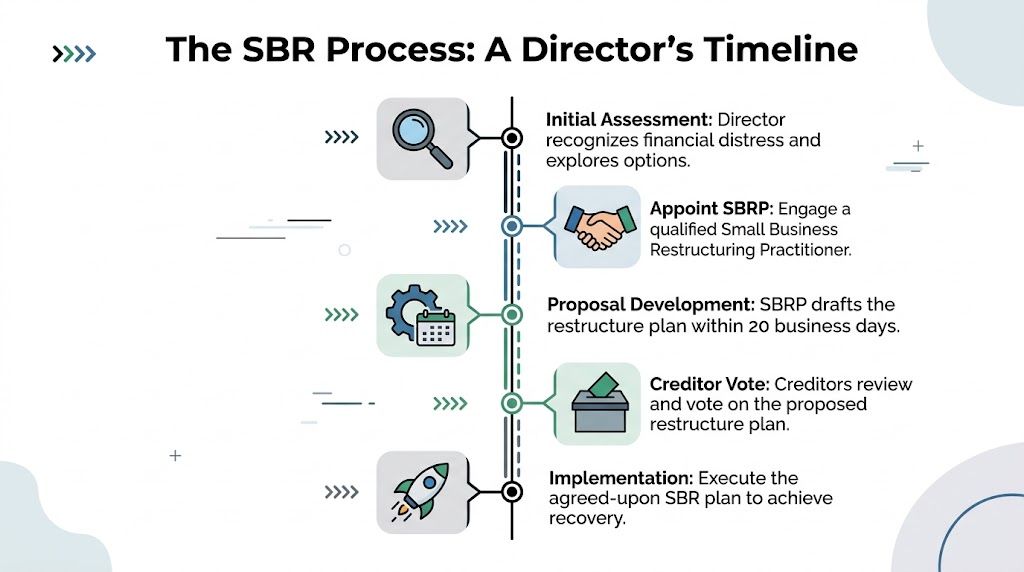
A SBR gives an eligible company a formal way to put a deal to creditors while the directors keep control of day-to-day trading. It has been available in Australia since 1 January 2021. For the right business, it can preserve operations, protect value, and avoid the blunt force of a liquidation process started too late.
As noted earlier, market use of the process has shown that creditors will consider these proposals when the business is viable and the plan is credible. That matters, but directors should not read that as a guarantee. It is a legal process with strict entry conditions, disclosure obligations, and timing pressure.
Why directors are paying attention
Directors pay attention to SBR for one simple reason. It gives a company with a workable core business a chance to deal with debt without handing over the business at the outset.
That trade-off is commercially attractive, but it comes with a burden that generic guides often gloss over. You need current books, up-to-date lodgements, no outstanding employee entitlements especially surrounding superannuation, and a proposal that matches what the business can produce. If those basics are missing, the process can fail before creditors even get to the substance.
I have seen viable companies miss the window because they treated restructuring as paperwork instead of strategy. By the time they sought advice, cash had drained, records were unreliable, and the director had already made decisions that narrowed the available options.
The practical rule is simple. Test SBR early, before pressure strips away your choices.
At LemonAide, we approach SBR as a director protection strategy as much as a business recovery process. That means asking the uncomfortable questions early, stress-testing eligibility, and dealing with the compliance issues that can derail an appointment. Done properly, SBR can buy time and hold the business together. Done poorly, it wastes cash and can leave you facing a harsher outcome with fewer defences.
What Exactly Is a Small Business Restructure
A small business restructure is best understood as a controlled financial reset for an eligible company. It is not liquidation dressed up with nicer language. It is a formal process under insolvency law that allows a company to propose a compromise to creditors while continuing to trade under director control.
In a liquidation, the focus turns to winding up the company and dealing with its assets and liabilities after the point of failure. In an SBR, the focus is different. The question is whether the business can keep operating if its historic debt is reworked into something achievable.
The director in possession difference
The feature directors care about most is the director-in-possession model. In plain English, that means you stay in control of the company while the restructure is underway. You don’t get removed from day-to-day management at the start.
That changes the emotional temperature immediately. You can keep dealing with staff, customers, suppliers, and projects while the formal process runs. You’re not standing on the sidelines watching someone else make every operational decision.
The legal framework matters here too. The SBR process is governed by Part 5.3B of the Corporations Act 2001. It’s a real insolvency pathway, but one designed to preserve viable small businesses rather than rush them into shutdown.
What the practitioner actually does
An SBR still involves a registered liquidator. A Small Business Restructuring Practitioner works with the company to assess eligibility, review the company’s position, and propose a formulated proposal of the Director that goes to creditors. That practitioner is not there to run your business for you. Their role is supervisory and procedural, with a focus on whether the company can properly enter the process and whether the proposed plan is supportable.
A short explainer helps if you want to see the mechanics at a high level.
What SBR is good for and what it is not
SBR is well suited to companies that are under pressure but still have a functioning business underneath the debt. Typical examples include businesses with strong revenue but poor historical tax management, margin compression, a bad expansion decision, or a short-term cash flow shock that became chronic.
It is not a cure for every problem.
If the business is not viable, restructuring debt won’t fix the core issue.
If records are poor, the process becomes harder, slower, and riskier.
If directors hide transactions or liabilities, the proposal can unravel fast.
If directors have received a lockdown Director Penalty Notice or the non-lockdown Director Penalty Notice has expired, the proposal will not help you.
That’s why experienced advice matters. The legal process is only one layer. The core work is matching the process to a business that can survive after the debt is reprofiled.
Are You Eligible for the SBR Pathway
A director usually finds out very quickly whether SBR is a realistic option or a distraction. The pressure is already on. The ATO is chasing, suppliers are tightening terms, and cash flow is being used to plug old holes. If the company cannot clear the entry rules early, time is better spent choosing a different path before someone else forces it on you.
Directors should check four issues before spending money on a formal appointment:
Debt cap: Do the company’s total liabilities fall within the $1 million limit, excluding employee entitlements that are not due and payable?
Employee Entitlements: Does the company have outstanding employee entitlements that are due and payable, such as last quarters or last year's superannuation or annual leave of an employee that left last month?
Prior use: Has the company, or a related entity caught by the rules, already gone through SBR or simplified liquidation in the last seven years?
Company structure: Is the business trading through an eligible company, rather than a sole trader or partnership?
Records and disclosure: Can you produce financials, tax records, and a clear explanation of the company’s position without guesswork?
Fail the debt cap or the employee entitlements test and SBR is automatically off the table.
Struggle with structure, records, or disclosure and the position becomes more nuanced. Legal eligibility may still be there, but practical eligibility starts to fall apart. I have seen directors assume they were ready because the debt number worked, then lose momentum because no one could reconcile liabilities, explain related-party payments, or prove employee obligations were under paid.
Readiness decides whether eligibility is useful
The better question is not whether you are technically eligible on paper today. The better question is whether the company is ready to survive the scrutiny that comes with the process.
That is the part generic guides gloss over.
A company can sit just under the debt cap and still be in poor shape for SBR. Lodgements may be overdue. Creditor balances may be wrong. Director loan accounts may be messy. Old payment arrangements may have collapsed without being properly recorded. None of those issues automatically kill the process, but they create friction, cost, delay, and risk. They also increase the chance that a creditor, or the practitioner, takes a harder look at trading conduct before the appointment.
A rushed SBR exposes weak records, unresolved compliance failures, and wishful forecasting very quickly.
What directors should review before going further
Issue
What directors should check
Liability position
Total company debts, including tax, trade creditors, loans, and contingent exposures
Employee obligations
Whether wages, leave, and super issues are current or likely to block progress
Tax compliance
Whether lodgements and records are current enough to support the process
Related party dealings
Whether past transactions will attract scrutiny or need explanation
Ongoing viability
Whether the company can trade profitably after debt relief
Directors, therefore, need disciplined advice, not optimism. We are not trying to make an ineligible company look eligible. We are trying to identify what can be fixed lawfully, what needs to be disclosed properly, and whether the business is worth protecting at all. That is the difference between using SBR as a director-first protection strategy and stumbling into a process that leaves your personal risk exposed.
At LemonAide, we treat this stage as triage. We test the numbers, pressure-test compliance, and call out the weak spots before they become expensive surprises. If SBR fits, we help you enter it in a controlled way. If it does not, we say so early and protect your room to act.
The SBR Process Step by Step Through a Director's Eyes
Monday starts with a supplier threatening to stop stock supply. By Tuesday, the ATO is chasing arrears again. By Wednesday, you are asking the question directors usually leave too late. Can this company be saved without handing over control or risking a worse outcome later?
That is what the SBR process feels like from the director's chair. You are still running payroll, dealing with staff, calming key creditors, and trying to protect cash. At the same time, every assumption is being tested. The process is legal, structured, and time-limited, but the pressure on management is commercial and immediate.
Directors often hear that SBR lets them stay in control. That is true, but only part of the story. You keep control while carrying a heavy compliance burden. If records are poor, cash flow is unstable, or old transactions cannot be explained, that burden lands on you fast.
Stage one. The decision point
The process usually starts after informal fixes have failed. Payment plans are breaking. Creditors are losing patience. Debt has stopped being a cash-flow issue and become a solvency issue.
At that point, the question is not whether the business is under pressure. You already know that. The question is whether the underlying operation can produce profit if legacy unsecured debt is dealt with. If the answer is no, SBR can waste time you may not have. If the answer is yes, the formal appointment of a Small Business Restructuring Practitioner may be the right next move.
This decision is strategic. Enter too early, and you may spend money on a process the business did not need. Enter too late, and you increase the risk of failed implementation, creditor hostility, and scrutiny of your trading conduct before appointment.
Stage two. The 20 business day build
Once the practitioner is appointed, the proposal period begins. Directors stay in control of day-to-day trading while the restructuring plan is prepared over 20 business days, as noted earlier.
On paper, that window looks workable. In practice, it is tight. You need clean financial information, a clear debt position, supportable trading forecasts, and a proposal creditors can accept as realistic. At the same time, the business still has to trade properly. Staff still need answers. Customers still expect delivery.
The directors who struggle here are usually not careless. They are overloaded. They assume the books are close enough, the tax position can be cleaned up later, or the plan can be built around optimistic sales. Creditors and practitioners test those assumptions quickly.
A workable proposal usually rests on four things:
Books that match reality. Accounting files, bank statements, aged creditors, debtors, and ATO data need to line up.
Forecasts that can survive scrutiny. If projected revenue depends on a sudden jump in performance, the weakness will be obvious.
Explanations for unusual transactions. Related party payments, asset transfers, and selective creditor payments need a clear story and proper records.
Tight management during the build period. Random spending, new liabilities, and inconsistent communication can damage the plan before creditors even see it.
Stage three. The compliance pressure generic guides miss
This is the part many articles gloss over. SBR is simpler than larger formal insolvency processes, but it is not light-touch for directors.
Employee entitlements that are due and payable must be paid before the plan can go to creditors, as explained in Access Intell’s creditor guide to SBR. For some companies, that requirement is the hardest obstacle in the whole process. A business may be viable after debt compromise and still struggle to fund those payments at the point they are required.
There is more. The practitioner needs reliable information. Directors must make formal declarations. Historic conduct may need review. If tax lodgements are missing, records are incomplete, or liabilities have been understated, the issue is no longer administrative. It can derail the plan or expose the director position more broadly.
This is also where personal asset protection becomes practical, not theoretical. Sloppy preparation can lead to questions about solvency, director conduct, and what was known before the appointment. Good advice at this point is not about selling SBR. It is about reducing avoidable risk while preserving the option if the company qualifies.
Stage four. Creditor voting
Once the plan is finalised, creditors move into the voting period. They are not judging your effort. They are judging return and credibility.
A poor proposal usually fails for predictable reasons. The numbers do not reconcile. The forecast looks inflated. Related party dealings are not explained properly. The business asks creditors to accept a haircut without showing why the offer is better than liquidation or continued default.
Creditors do not need to trust your optimism. They need enough evidence to believe the plan is achievable and worth backing. That is why presentation matters. So does timing. So does the quality of the financial material behind the proposal.
Stage five. Living under the plan
Approval is not the win. Performance is.
Once the plan is accepted, the company has to make the agreed contributions and trade with discipline for the full term of the arrangement. Directors who treat approval as the end of the crisis often end up in trouble again. The same habits that created the pressure the first time can destroy the restructure the second time.
That is why some directors use support around the statutory process, not just inside it. Firms such as LemonAide provide director-focused pre-insolvency and debt advisory support. That can include reviewing the wider business and personal position, helping prepare for the formal process, and assisting with implementation decisions while the practitioner handles the statutory role.
From the director's side, the SBR process is not a formality. It is a compressed test of viability, discipline, and credibility. If you enter it prepared, it can preserve the business and contain personal exposure. If you enter it hoping the process itself will fix weak records or poor decisions, it can fail very quickly.
SBR vs Other Insolvency Options A Director's Choice
A director usually reaches this point under pressure. Cash is tight, creditors are louder, and every option feels expensive in a different way. The key question is not which label sounds safer. The question is which process gives your company a credible chance of survival without exposing you to more personal risk than necessary.
SBR sits in a very different category from voluntary administration and liquidation. If the company is still viable, records are in order, and the business can fund a realistic compromise with creditors, SBR can preserve trading and keep directors in control. If those elements are missing, forcing an SBR often wastes time you do not have.
If you do not qualify for an SBR, reach out to talk to one of LemonAide's qualified representatives about your other alternatives that suit your circumstances.
What the outcomes actually mean for directors
As noted earlier in the article, ASIC's REP 810 report points to strong completion and business survival outcomes for many companies that entered and fulfilled SBR plans. Used properly, that matters. It means SBR is not just a legal shelter while the business deteriorates. It can work as a genuine recovery mechanism.
But directors need to read those outcomes carefully. They do not prove that every distressed small business should restructure. They show that eligible companies with a workable business, current compliance, and disciplined execution can come out the other side intact. That is a narrower group than many generic guides suggest.
The practical comparison
Feature
Small Business Restructure (SBR)
Voluntary Administration (VA)
Liquidation
Director control
Directors usually remain in day-to-day control while the plan is prepared and put to creditors
Control passes to the administrator
Control ends and the liquidator takes over
Core objective
Compromise debts and keep the company trading
Stabilise the company, investigate options, and decide whether a deed or winding up is appropriate
Wind up the company and realise assets for creditors
Cost profile
Often more workable for smaller companies that qualify
Commonly more expensive and heavier to run
Costs still apply and can reduce returns from remaining assets
Operational impact
Trading can continue with less disruption if handled properly
Operations often become harder, with sharper effects on staff, suppliers, and customers
Business continuity usually ends or shrinks fast
Investigation pressure
Still serious, but aimed at supporting a restructure proposal
Formal review begins under external control
Liquidator scrutiny of conduct, records, and recoveries becomes a central feature
Best fit
Viable small company with a realistic offer to creditors
Company needing external control, breathing space, or broader restructuring options
Company has no realistic path back to solvent trade
Where SBR is often the better choice
SBR is usually the stronger option where the business itself still makes sense, but the debt burden has become too heavy to service in the ordinary course. The company may have solid sales, decent margins, and loyal customers, yet still be choking on tax debt, legacy arrears, or the tail-end effect of a rough period.
That is the sweet spot. Directors keep control. The brand is not pushed straight into a public insolvency event with the same shock effect as VA or liquidation. Suppliers and staff often have a better chance of staying on side if the process is prepared properly and the proposal is credible.
From a director's perspective, that control matters. It can also be dangerous if you misread the business. Control only helps when the company is capable of performing under a plan.
Where VA or liquidation may be the better call
Some businesses need external control, not another chance to self-manage under pressure.
VA can make more sense where there are major disputes between stakeholders, serious governance issues, uncertain asset positions, or a need to move quickly under an administrator's authority. It is heavier and more disruptive, but sometimes that is exactly the point. If confidence in management has broken down, a director-led process may not be persuasive to creditors.
Liquidation is often the right call where the business is no longer commercially viable, losses are continuing, records are poor, or further trading is likely to worsen the position. Directors sometimes resist this because it feels like failure. In practice, delayed liquidation can produce the worst outcome of all. More tax debt builds. More creditors go unpaid. Personal exposure can get worse.
We tell directors this plainly. Saving a dead business is not a strategy.
The trade-off directors often miss
The attraction of SBR is obvious. Lower cost than VA in many cases. Less disruption. More control. Better chance of preserving the company than Liquidation.
The hidden burden is compliance and execution.
An SBR only works if the company can meet the entry rules, produce reliable numbers, put forward an offer creditors can accept, and then perform that plan over time. If the books are weak, the tax position is muddled, or the forecast is built on hope rather than evidence, SBR can fail quickly. Directors who enter too late often discover that the legal process did not create viability. It only tested whether viability already existed.
Experienced pre-appointment advice holds practical importance. Director-first advisers such as LemonAide help test whether SBR is suitable before you commit to a formal path, and that can protect both the business and your personal position from a bad call made in panic.
The director's decision standard
Choose SBR if the company is still viable, eligibility is clear, and you can support a realistic proposal with clean records and disciplined trading.
Choose VA if outside control is needed to stabilise the situation or deal with complexity that SBR cannot handle.
Choose liquidation if the business cannot be saved without digging the hole deeper.
Directors lose options by hesitating and by choosing the least confronting process instead of the right one. The right call is the one that matches the facts, contains risk early, and gives creditors a better outcome than the alternatives.
Your Practical Checklist Before Starting an SBR
If you think SBR may be relevant, your first job is not to announce it. Your first job is to get organised. Distressed companies lose options when directors keep trading blind.
Stop the damage first
Before you look at any formal process, stabilise the business.
Freeze non-essential spending: If a cost doesn’t protect revenue, compliance, or core operations, question it.
Stop improvised creditor deals: Side promises made under pressure often create inconsistency and later problems.
Protect records: Don’t let panic produce messy bookkeeping or undocumented payments.
Build a clean information pack
Most directors know less about their real debt position than they think. You need one working file that pulls the facts together.
Accounting file up to date in Xero, MYOB, or your current system.
Bank statements across all accounts.
ATO portal information and a clear tax debt summary.
Aged creditor list and aged debtor list.
Payroll and employee entitlement position showing up to date.
Loan schedules, director loan accounts, and related party balances.
Major contracts, leases, and any litigation or demand letters.
This isn’t busywork. It’s how you find out whether the company can support a formal proposal or whether there’s a deeper structural issue that needs a different response.
Ask the hard commercial questions
Before you spend time and money on a formal pathway, test viability bluntly.
Are sales still real and collectable?
Is margin good enough when pricing is honest?
Are losses caused by debt pressure, or is the business losing money due to its fundamental operations?
Could the company trade normally if historic unsecured debt was dealt with?
If you can’t answer those questions, you’re not ready.
Get advice before the crisis chooses for you
The right early conversation is confidential, practical, and brutally clear. It should cover both the company and your personal exposure, including guarantees, director risk, asset position, and what options remain if SBR isn’t available.
Directors often wait too long because they assume advice starts with surrender. It doesn’t have to. Good pre-insolvency advice starts with preserving optionality, getting facts straight, and making sure you don’t accidentally worsen your position while trying to save the business.
Beyond the Restructure What Happens Next
Creditor approval is a milestone, not the finish line.
What matters next is execution. If the company misses plan payments, falls behind on current obligations, or slips back into poor financial control, the benefit of the restructure can disappear quickly. I’ve seen directors work hard to get a proposal accepted, then lose ground because they treated approval as relief instead of a stricter operating standard.
The better view is simple. An SBR gives the company a second chance to trade properly. It does not fix weak pricing, bad reporting habits, unmanaged tax exposure, or a business model that was already failing before the debt pressure hit.
Completion matters more than approval
Earlier ASIC reporting referenced in this article points to a practical reality. Plans that are completed can support genuine business continuity. That is the outcome directors care about. Keeping the company alive, compliant, and commercially stable.
That result takes work. The post-approval period usually demands tighter controls than the business had before distress, not looser ones.
The seven-year restriction should change your behaviour
One point too many generic guides treat lightly is the seven-year restriction on using the SBR pathway again, as noted earlier in the article.
For directors, that has real strategic weight. If you use this process now, then run back into serious trouble inside that period, this option may not be there to protect the company the second time. That is why we push directors to treat an SBR as a reset point for the whole business, not just a debt compromise.
Use the breathing room to fix the causes, not only the symptoms.
What disciplined directors do after approval
Directors who get through an SBR and stay out of repeat distress usually focus on a few practical areas.
Keep accounts current and readable. If management numbers are six weeks late, you are operating blind.
Stay current on tax, super, and lodgements. Some old debt can be compromised. New non-compliance creates fresh risk.
Protect margin. If your pricing still does not cover labour, overhead, and finance pressure, the restructure has bought time but not solved the problem.
Watch related party dealings and director drawings. Sloppy transactions after approval can create new problems fast.
Review personal exposure. Guarantees, security positions, and asset ownership should be revisited while the company is stable enough to act.
Control growth. New work, new staff, and new sites can strain cash before they produce profit.
This is also the stage where director-first advice matters most. LemonAide works with directors after approval to keep the company on plan, tighten compliance, and assess whether any personal asset protection steps should be considered separately from the company process. That is the part many firms ignore. It is also where avoidable mistakes usually happen.
A completed restructure should leave you with a cleaner balance sheet and a stricter way of running the business. If it only leaves you with less debt, the job is half done.
Frequently Asked Questions about SBR
Does an SBR protect me from personal liability
An SBR can stabilise the company. It does not wipe out your personal exposure.
If you have signed personal guarantees, borrowed in your own name, mixed personal and company funds, or dealt with related entities loosely, those risks sit outside the company compromise and need separate review. Directors get caught here because they assume saving the company also fixes their own position. It does not. We assess both at the same time because a company plan that leaves your personal assets exposed is only half a strategy.
What happens if creditors vote no
If creditors reject the proposal, the plan does not take effect and time is usually the first casualty. Cash keeps tightening, pressure from the ATO or suppliers tends to increase, and your remaining options can narrow fast.
Preparation decides a lot here. A proposal built on weak records, optimistic forecasts, or unresolved creditor issues can fail for reasons that were visible before it went out. Once that happens, you may need to shift quickly into voluntary administration, liquidation, or another turnaround path while there is still something worth preserving.
How much does an SBR really cost
Cost depends on the state of your books, the number of creditors, the quality of your financial records, and how much cleanup is needed before a practitioner can put a credible plan forward.
Practitioner fees are only one part of the spend. Directors often also face accounting catch-up work, cash flow forecasting, legal advice on disputed debts or guarantees, and separate advice on personal risk. Cheap day one advice can turn expensive if the proposal is poorly prepared, rejected, or approved but impossible to complete.
Can I choose which creditors are included
The process applies to eligible pre-appointment unsecured debts under the legal framework. It is not a selective deal where directors decide who gets counted and who gets left out for convenience.
That is a common mistake. If there is a major creditor, a related party balance, or a disputed amount that could affect voting or confidence in the plan, it needs to be addressed properly before documents go out. Mishandling creditor treatment can sink the proposal and raise harder questions about director conduct.
Do I keep running the business during the process
Yes. Directors usually stay in control of trading while the restructure is on foot, with the practitioner overseeing the process and the proposal.
That control is useful, but it cuts both ways. You still need clean records, disciplined cash handling, current reporting, and a clear explanation for unusual transactions. If the business keeps trading badly during the process, staying in the chair becomes a risk, not a benefit.
Is SBR only for ATO debt
No. Tax debt often drives the conversation, but SBR can deal with a broader mix of unsecured liabilities, including supplier debt and other ordinary unsecured claims.
The better question is whether the business can trade profitably after the old debt burden is compromised. If the core business still loses money, the debt type matters less than directors hope.
What if my business has unpaid employee entitlements
This needs attention early as if it remaions unpaid it is an automatic disqualifier if it is due and payable and not paid prior to the appointment of a Small Business Restructuring Practitioner.
Is SBR always the right move if I’m eligible
Eligibility only means you can consider the pathway. It does not mean the business is viable or that SBR is the best option.
Some companies need a different form of restructuring. Some should stop trading before losses deepen further. Some directors need to focus first on personal guarantees, asset exposure, and whether continuing to trade creates more risk than value. That is why we push for a director-first review before any appointment. The company position matters, but your position matters too.
If you’re weighing up a small business restructure sbr and need a director-focused review of both the company and your personal position, LemonAide offers confidential pre-insolvency and debt advisory support across Australia. Start with a clear assessment of viability, eligibility, risk areas, and the alternatives before a creditor or cash flow crisis makes the decision for you.
https://www.lemonaide.com.au/wp-content/uploads/2026/04/small-business-restructure-sbr-business-advice.jpg7361312IvanaKKatzAdmin2024https://www.lemonaide.com.au/wp-content/uploads/2024/06/Lemonaide-Logo.pngIvanaKKatzAdmin20242026-04-22 12:01:022026-04-22 12:01:42Small Business Restructure SBR: Save Your Business
When you’re staring down the barrel of a financial crisis, it’s easy to feel like the walls are closing in. Creditors are calling non-stop, cash flow has all but evaporated, and terms like voluntary administration start getting thrown around. But what does it actually mean?
Let's cut through the jargon. Voluntary administration is a formal process under Australia's Corporations Act 2001. It's designed for a struggling company that might still be viable, giving it a chance to restructure and survive.
What Is Voluntary Administration?
Think of it as hitting a giant ‘pause’ button. When your board of directors decides the company either is, or is likely to become, insolvent (meaning it can't pay its debts as they fall due), they can appoint an independent, qualified insolvency practitioner to step in as the administrator. This single move provides immediate, powerful breathing room.
The moment the administrator is appointed, a moratorium kicks in. This is a legal freeze on most claims from creditors. Unsecured creditors, landlords, and even the ATO are generally stopped in their tracks, unable to start or continue legal action to chase their money. This freeze buys the administrator time to take complete control of the company and dive deep into its financial affairs.
The core purpose of voluntary administration is to maximise the chances of the company, or as much of its business as possible, continuing to exist. If that's not possible, the goal shifts to achieving a better return for creditors and members than would result from an immediate winding up of the company.
Crucially, this isn't an instant death sentence for your business. It’s a structured pathway to find the best possible outcome for everyone involved. But make no mistake: it’s a formal and expensive process that takes all control out of your hands as a director. An alternative, like working with LemonAide, allows you to explore private solutions first, which can often save the business without the need for this drastic public step.
To get a clearer picture, it helps to see how voluntary administration stacks up against going straight into liquidation.
Voluntary Administration vs Direct Liquidation At a Glance
The choice between these two paths comes down to your primary goal: are you trying to save the business, or is it time to close the doors for good? This table breaks down the key differences.
Aspect
Voluntary Administration
Direct Liquidation
Primary Objective
To rescue and restructure a viable business, or parts of it.
To wind up the company's affairs and cease operations.
Control
The administrator takes full control. Directors lose their powers.
The liquidator takes full control. Directors lose their powers.
Potential Outcomes
Deed of Company Arrangement (DOCA) with control of the company returning to directors, in very rare circumstances the Voluntary Administration ends again with control of the company returning to the directors or liquidation.
Dissolution of the company after assets are sold and distributed.
As you can see, voluntary administration is built around the possibility of a comeback. Liquidation, on the other hand, is the end of the line for the company. Working with a service like LemonAide before making either choice can help you determine if a private rescue is possible, which is a far better alternative than both formal options.
The Recent Surge in Formal Appointments
It's not just you. More and more businesses are being forced into formal insolvency processes like voluntary administration. As the economy tightens and the ATO ramps up its debt collection, the pressure on directors is immense.
Recent data paints a stark picture: in the 12 months to March 2024, a total of 10,268 insolvency appointments were recorded. That's a staggering 53% increase from the previous year, showing just how tough the current environment is. You can dig into the full corporate insolvency report here for a deeper dive into these trends.
The Smarter Alternative to a Formal Mess
While voluntary administration has its place, it's a reactive move made when a crisis has already hit boiling point. A much smarter path is to engage a pre-insolvency specialist like LemonAidebefore things get that dire.
We work for one person: you, the director. Our job is to find private, confidential, and director-controlled solutions. This could mean informal creditor negotiations, a quiet strategic restructure, or other options that keep you in the driver's seat and avoid a public, formal appointment altogether.
Acting early with LemonAide opens doors that an administrator—who is legally bound to act for all creditors—simply cannot. It's the difference between being tossed about by the waves and having an experienced navigator help you steer through the storm with a clear plan.
A Step-by-Step Look at the Voluntary Administration Process
Going into voluntary administration can feel like you’ve been thrown into a legal maze with no map. Getting your head around the process, the timeline, and what happens at each stage is the first step to finding your way out. It’s a very formal process, but knowing what’s coming allows you to plan your moves instead of just reacting to what’s thrown at you.
An independent administrator runs the whole show, and their job is to get the best result for all the creditors. But here’s the thing: before you go down this very public and stressful path, a quiet chat with a director-focused advisor like LemonAide can open up private options you didn’t know you had. If there's no other way forward, we make sure you walk into administration prepared and from a position of strength, not desperation.
Stage 1: The Appointment and the "Time-Out"
It all officially starts when the company's directors, seeing that the business is insolvent (or about to be), make the call to appoint an administrator. This is a huge decision. From that moment, you hand over the keys to the entire kingdom—the company, its bank accounts, assets, and day-to-day operations—to this outsider.
At the moment an administrator is appointed, a legal shield called a moratorium slams down. Think of it as a mandatory "time-out" for anyone you owe money to. This freezes most unsecured creditors in their tracks, stopping them from starting or continuing any legal action to chase their debts. It’s designed to give the administrator some much-needed breathing room to figure out what’s going on without being hounded by legal threats.
Stage 2: The Administrator's Investigation
With that time-out in effect, the administrator rolls up their sleeves and starts digging into the company's finances. They’ll take control of all your books and records, pour over cash flow statements, list out every asset, and put past transactions under a microscope. Their mission is to get a complete, unvarnished picture of the company’s business, property, and financial state.
As a director, you're legally required to give them all reasonable help. This means handing over every record and piece of information they ask for. But remember, while the administrator is meant to be neutral, their primary focus is the company and its creditors. This is where having LemonAide in your corner makes a massive difference—we represent you, helping you understand your obligations while fiercely protecting your personal interests during this intrusive phase.
A key part of the administrator's job is to form an opinion on three possible futures: review the proposed Deed of Company Arrangement (DOCA), in very rare circumstances end the administration and give the company back to the directors, or wind the company up through liquidation. Everything they uncover in their investigation is building towards the final recommendation they'll make to creditors.
Stage 3: The First Creditors' Meeting
This meeting is usually held within eight business days of the appointment and is mostly for show-and-tell. The administrator will introduce themselves, confirm they've been appointed, and give a quick rundown of what they’ve found so far.
Creditors really only have two big decisions to make here:
Form a Committee of Inspection: They can vote to create a small committee that will work more closely with the administrator and act as a voice for all the other creditors.
Replace the Administrator: If the creditors aren't happy with the administrator the directors chose, they have the power to vote them out and bring in their own registered administrator.
Stage 4: The Second and Final Creditors' Meeting
This is the big one. Usually held around 20-25 business days into the process, this is where the company’s fate is ultimately decided. Before the meeting, the administrator sends out a detailed report to every creditor.
This crucial report spells out:
What their investigation uncovered.
The company’s true financial position.
The administrator's opinion on the three possible outcomes (DOCA, end the voluntary administration, or liquidation).
Their recommendation for which path they believe will give creditors the best return.
At this meeting, the creditors vote on what happens next. The administrator's recommendation carries a lot of weight, but the final call belongs to the creditors. This is exactly why a solid game plan before you even enter voluntary administration is so vital. By working with LemonAide beforehand, we can help you build a viable proposal for a Deed of Company Arrangement (DOCA), massively improving the odds that creditors will vote to save your business instead of killing it off.
Understanding the Administrator's Role and Director Duties
When your company enters voluntary administration, the power shift is immediate and absolute. Think of it like someone else being handed the keys to your car, your house, and your bank account all at once. The administrator isn't just an advisor; they become the company's new controlling mind.
From the second they're appointed, the administrator takes full control of everything: the business, its assets, the bank accounts, and all operational decisions. Your power as a director is effectively put on ice. You can't sign contracts, make payments, or manage the company's affairs any longer.
The Administrator's Powers and Primary Duty
The administrator is a registered liquidator, an independent professional with sweeping powers under the Corporations Act 2001. Here's the crucial part: their fiduciary duty is not to you. It's to the company and, more importantly, its creditors. Their job is to get the best possible outcome for the creditors as a group.
This means they will:
Investigate the company’s affairs: They'll dig deep into the business's history, its finances, and what went wrong.
Take control of assets: They manage, protect, and can sell company assets to maximise the money available for creditors.
Run or wind down the business: They have the authority to keep trading if they think it helps the chances of a successful restructure, or they can shut the doors immediately.
Report to creditors: They must provide detailed reports to creditors and call meetings to decide the company’s fate.
This infographic breaks down the core stages the administrator will steer the company through.
It looks simple enough, but each step is managed by the administrator, a neutral party whose job is to follow the rulebook. In contrast, using LemonAide allows you to explore director-led alternatives that keep you in control and avoid this formal, public process altogether.
Your New Role: Your Director Duties
Just because your decision-making powers are gone, don't think your duties have vanished with them. You now have a legal obligation to provide "all reasonable assistance" to the administrator. This is non-negotiable.
Your legal duty during voluntary administration is to cooperate fully. This means handing over all company books and records, showing up to meetings, and answering any questions the administrator has about the company's business, property, or transactions. Failing to cooperate can lead to serious penalties.
This can feel incredibly confronting. You're legally required to help someone who is actively investigating your past actions, including looking for potential insolvent trading. It's a common point of stress for directors, especially when you're worried about personal assets. If you want to know more, you might find our guide on what happens to a director when a company is liquidated useful.
The Critical Difference: LemonAide Is on Your Side
This is the most important thing you need to grasp: the administrator is neutral, but we are not. The administrator works for the benefit of all creditors. We work exclusively for you.
While the administrator is busy digging through the company’s past, our focus is squarely on protecting your future. We act as your private, strategic advisor, making sure your interests don't get bulldozed in the process.
Here’s what having an advocate like LemonAide in your corner really means:
Strategic Communication: We help you manage every conversation with the administrator, ensuring you meet your legal obligations without accidentally putting your personal assets at risk.
Liability Defence: We prepare you for the investigation and work to defend you from personal liability claims, including nasty insolvent trading allegations.
Rights Protection: We make sure your rights as a director are respected every step of the way.
Proposal Development: We can help you put together a viable Deed of Company Arrangement (DOCA) proposal that gives your business the best chance of survival and protects you.
An administrator simply cannot offer this kind of personal advocacy; their role forbids it. Think of them as the referee, focused on enforcing the rules of the game for everyone. We're your coach, working with you to build the winning strategy before you even step onto the field.
What Are the Possible Outcomes of Voluntary Administration?
The whole point of voluntary administration is to force a decision. That intense period of investigation, negotiation, and frantic activity all comes to a head at the second creditors’ meeting. This is where the company’s fate is decided.
When it all shakes out, there are really only three ways this can go.
Knowing what these outcomes mean in the real world is everything. It’s the difference between saving your business, watching it get broken up and sold, or—in very rare cases—getting the keys back. This is where directors who’ve planned ahead have a massive advantage. Hoping for the best usually leads to the worst, but walking in with a solid strategy from a service like LemonAide can completely change the game.
Outcome 1 The Deed of Company Arrangement (DOCA)
This is the goal for most directors wanting to save their business. A Deed of Company Arrangement, or DOCA, is a formal deal struck between the company and its creditors. It’s a binding compromise that lets the business keep trading while settling its debts, usually for a better return than creditors would see from a fire-sale liquidation.
Think of it as a negotiated financial reset for the company.
A DOCA lays out a new set of rules. Typically, it will involve things like:
Creditors agreeing to accept a partial payment, like a certain number of cents in the dollar, over a set period.
A "time-out" on payments, giving the company breathing room to get its finances in order.
The sale of specific, non-essential assets to raise funds for the deal.
Once creditors vote 'yes' on the DOCA, the voluntary administration officially ends. The DOCA document is prepared and executed and then control is then handed back to the directors (or a new owner) to run the business under the agreed terms.
The Power of Pre-Insolvency Planning
A successful DOCA doesn't just happen. Creditors are not going to agree to a deal out of the goodness of their hearts; they need a commercially sound proposal that shows them they'll get more money back this way than any other. This is precisely why getting a specialist like LemonAide involved before you even appoint an administrator is a game-changer.
We work with you to build a compelling DOCA proposal before the clock even starts ticking. By having a fully-baked plan ready to go, you enter the process from a position of strength, not scrambling in desperation. This dramatically increases the chances that the administrator will recommend your proposal and that creditors will vote for it.
Outcome 2 End the Voluntary Administration
This is the unicorn of voluntary administration outcomes—it’s incredibly rare. It only happens if the administrator digs into the company’s books and finds that it was actually solvent the whole time. If that’s the case, the administration ends, and the company is simply handed back to the directors to carry on as if nothing happened.
This path is almost unheard of. A company enters voluntary administration because it's believed to be insolvent. To prove it was solvent all along usually means the initial appointment was a mistake or the result of a temporary, ill-advised panic.
While it sounds ideal, its rarity means you absolutely cannot bank on this happening. It’s a stark reminder of why getting accurate financial advice early on from a service like LemonAide is so critical to understanding your true solvency position in the first place, potentially avoiding this formal process entirely.
Outcome 3 Liquidation
If creditors vote down a DOCA proposal, or if no realistic deal is ever put forward, the default outcome is liquidation. At that second meeting, creditors will vote to wind up the company, and the process flips immediately from a potential rescue to a final shutdown.
The administrator typically just changes hats and becomes the liquidator. Their job is no longer about saving the business; it's about closing it down in an orderly way. They will sell off every company asset, chase any potential claims (like insolvent trading against directors), and distribute whatever money is left to creditors in a strict order of priority. For the company, this is the end of the line.
The construction industry has seen far too much of this outcome lately. Between May 2024 and May 2026, the sector was hit with a wave of failures, with 2,636 construction companies becoming insolvent in the 12 months to March 2026 alone—a massive 23% jump from the year before. You can learn more about the building industry insolvency crisis and see why it’s a brutal lesson in the need for early, strategic advice. Without a plan, liquidation is almost inevitable. A better alternative is getting advice from LemonAide to attempt a private workout or restructure, which can prevent liquidation.
Protecting Your Personal Assets from Business Debts
For any director staring down the barrel of financial trouble, one question screams louder than all the others: "What about my house?" The fear of losing the family home or your life savings because the business went under is a heavy weight to carry. It’s also one of the main reasons so many directors put off asking for help.
So let’s be crystal clear about what voluntary administration can—and can’t—do to protect your personal assets.
There’s a dangerous myth that putting your company into voluntary administration throws an automatic shield around your personal wealth. It absolutely does not. Voluntary administration is a process designed for the company, not for you as an individual director. It doesn't magically wipe out any personal liabilities you've racked up.
The "corporate veil" is supposed to separate a company's finances from a director's personal life. But that veil can be pierced. Things like personal guarantees, director loans, and ATO director penalty notices can punch right through it, putting your personal assets squarely in the firing line.
If you’ve signed a personal guarantee for a business loan, for instance, that creditor can come after you directly for the debt. The company being in administration won't stop them. This is one of the biggest risks directors face, and you can learn more about what can happen with personal guarantees in our detailed guide.
When Business and Personal Debts Collide
The line between business debt and personal debt can get dangerously fuzzy, fast. According to the Australian Financial Security Authority (AFSA), there were 1,169 new personal insolvencies in September 2024 alone. Even more telling is that 350 people who entered personal insolvency in March 2024 were also involved in businesses, often in sectors like construction and transport. You can explore more statistics on personal insolvency from AFSA.
This is where the standard insolvency process just doesn’t cut it for directors. An administrator is appointed to the company. Their legal duty is to focus only on the company’s affairs and get the best result for creditors. They have zero obligation to advise you on your personal exposure. In fact, their investigation might actually dig up reasons to come after you personally.
The LemonAide Difference: A True Firewall
This is exactly the gap LemonAide was built to fill. An administrator can only deal with the company, but we look at your entire financial picture—both business and personal. Our one and only job is to protect you.
We offer a service that an Administrator simply can't. We analyse your whole situation to build a complete strategy that deals with the company’s debts while creating a legal firewall to protect your personal wealth.
Here’s how our process works:
A Full Analysis: We dive deep into your company structure, personal guarantees, any director loans, and your ATO liabilities.
Asset Protection Strategy: We find the legal pathways to safeguard your family home and other personal assets from creditors.
Negotiation Support: We can negotiate on your behalf, not just for the company, but for your personal liabilities as well.
This approach gives you a single, integrated plan to manage the crisis. You get a strategy for the business and, just as importantly, a shield for your family.
Exploring Better Alternatives to Voluntary Administration
When your company hits financial trouble, it's easy to think voluntary administration is your only option. It’s the name everyone knows, and it can feel like the only lifeline being thrown your way.
But here’s the thing we’ve seen countless times: it’s often the last, most public, and expensive resort. It’s a reactive move that means you’re handing the keys to your business over to a complete stranger, the administrator, who then dictates its future.
The smarter play is almost always to get on the front foot with a service like LemonAide. There are director-led alternatives that keep you in control. These are private, often far more effective solutions that you can only access by seeking advice before a crisis hits. It’s the difference between being a passenger bracing for a crash and grabbing the wheel with an expert navigator riding shotgun.
Informal Workouts and Private Negotiations
Long before you need to google what is voluntary administration, you have the option of a private negotiation. We find that many disputes with creditors, including the Australian Taxation Office (ATO), can be sorted out with an informal workout. This is simply a confidential negotiation process that you manage, with our expertise to back you up.
Instead of a formal, public process governed by rigid legal rules, we help you:
Build a payment plan proposal that is actually realistic and affordable for your business.
Put your case forward to the ATO and other creditors professionally.
Negotiate a compromise that lets your business keep trading, without the black mark of a formal insolvency appointment against its name.
This approach is faster, cheaper, and crucially, keeps your financial challenges out of the public eye. It helps preserve the business relationships you’ve built and gives you the flexibility to find a resolution that actually works. With LemonAide, this becomes a far more effective and less stressful alternative to formal administration.
You can think of it like this: Voluntary administration is major surgery performed in a public operating theatre. An informal workout with LemonAide's help is like seeing a specialist for targeted treatment behind closed doors—often avoiding the need for that surgery in the first place.
The Small Business Restructuring Process
If you run an eligible small business, there’s another powerful tool at your disposal called Small Business Restructuring (SBR). This was introduced as a streamlined process designed to be quicker and less expensive, with one huge advantage: directors stay in control of the company.
Unlike voluntary administration, where an administrator takes charge from day one, the SBR process lets you keep running the business day-to-day. You work alongside a restructuring practitioner to put a formal proposal to your creditors, which they then vote on. LemonAide can help you navigate this process, ensuring it's the right fit and giving you the best chance of a successful outcome, making it a superior alternative to voluntary administration for eligible businesses.
Strategic Corporate Restructuring
Sometimes the best path forward involves more than just a payment plan. It requires making targeted, strategic changes to your company's structure. This isn't about giving up; it’s about being smart to protect your valuable assets and allow the profitable parts of your business to thrive.
A strategic corporate restructure might involve setting up a new company to acquire the healthy parts of the old one, or changing the ownership structure to legally shield key assets from creditors. You can read more in our guide on corporate restructure.
By getting advice from us at LemonAide early on, we can map out these kinds of sophisticated strategies. These are options an administrator simply can't offer you, and they can be the key to securing your financial future while still responsibly dealing with legacy debts.
We Get Asked These Questions a Lot
When you're staring down the barrel of voluntary administration, your head is probably swimming with questions. It’s a complex space, and the answers aren't always straightforward. Here are some of the most common questions we hear from directors in your shoes, with the no-nonsense answers you need.
How Much is This Going to Cost Me?
Let’s be blunt: voluntary administration is expensive. The costs are significant and they come straight out of the company’s assets. An administrator charges for their time, and those fees can easily spiral into tens of thousands of dollars, even for a smaller business.
Every dollar paid to the administrator is a dollar that can't go to your creditors. It's one of the biggest reasons we always tell directors to explore more affordable, private options with an advisor like LemonAide first. Our services are designed to be a far better value alternative, often achieving a better result for a fraction of the cost of a formal appointment.
Can I Keep Working in the Business?
Once an administrator steps in, you, as a director, lose control. All decision-making power is gone. That said, the administrator isn't a magician; they don't know your business like you do.
It’s common for them to ask you to stay on and help run the day-to-day operations. But make no mistake, your role changes completely. You’re essentially an employee taking orders from them, not the one calling the shots. This is a key reason why director-led alternatives offered by LemonAide, like informal workouts or Small Business Restructuring, are a better option as they keep you in control.
Will This Stop the ATO Chasing Me?
Yes, appointing an administrator triggers an immediate freeze (a moratorium) on most actions from unsecured creditors. This includes the ATO, putting a stop to recovery actions like garnishee notices against the company.
However—and this is a big one—it doesn't automatically protect you from personal liability under a lockdown Director Penalty Notice (DPN).
It's critical to understand that the freeze on ATO action is only temporary. An administrator can’t give you personal advice as they have a fiduciary duty to the comapny's creditors. A pre-insolvency advisor like LemonAide, on the other hand, can work with you to build a strategy to tackle that DPN head-on, which is a far better and more complete solution.
Can I Propose My Own Deal (DOCA)?
Absolutely. As a director, you can—and often should—put forward a Deed of Company Arrangement (DOCA). This is your proposal to creditors for a way to save the business and pay back a portion of the debt.
But a flimsy, poorly thought-out proposal will be dead on arrival. Creditors will reject it in a heartbeat. Your best shot at getting a DOCA across the line is to have a commercially viable, watertight proposal developed before you even enter administration. This is where LemonAide can make all the difference, helping you build a compelling case that an administrator will actually recommend and creditors will be willing to accept.
What If I Don’t Cooperate with the Administrator?
Simply put: don't do it. Failing to cooperate is a serious offence under the Corporations Act 2001. You are legally required to hand over all company books and records and provide any reasonable assistance they ask for.
Being difficult won’t help you. It will lead to liquidatation of the company as the administrator can not properly evaluate your DOCA proposal against a potential liquidation and it will definitely put your conduct as a director under a very negative spotlight. Having LemonAide on your side can help you manage these interactions, ensuring you cooperate fully while still protecting your personal position.
Feeling overwhelmed by all this is completely normal. But you don't have to figure it out on your own. The single best thing you can do right now is get expert advice before you're backed into a corner. The team at LemonAide offers a free, confidential chat to give you a clear roadmap, help protect your personal assets, and look at private solutions that keep you in control. Take the first step toward a fresh start and visit www.lemonaide.com.au today.
https://www.lemonaide.com.au/wp-content/uploads/2026/04/what-is-voluntary-administration-question.jpg7361312IvanaKKatzAdmin2024https://www.lemonaide.com.au/wp-content/uploads/2024/06/Lemonaide-Logo.pngIvanaKKatzAdmin20242026-04-08 09:45:152026-04-08 09:45:21What Is Voluntary Administration in Australia?