
Can Liquidators Take Your House in 2026?
When you’re staring down the barrel of company liquidation, one question almost always screams the loudest: "Can the liquidator take my house?"
For most directors, the short answer is no. There's a solid legal wall separating the company's mess from your personal life, and a liquidator's job is to deal with the company's assets, not yours.
Understanding the Risk to Your Home in Liquidation

The thought of losing the family home is terrifying, and it's a fear I see in almost every director facing financial distress. This panic usually comes from a misunderstanding of what a liquidator can actually do. It’s vital to remember that your company is its own legal person, totally separate from you. The liquidator is appointed to manage the company's affairs, not your personal ones.
But—and this is a big but—that protective wall isn’t unbreakable. Certain decisions you might have made, often without realising the long-term risk, can punch holes right through it. Suddenly, your personal assets, including your home, are in the firing line.
When the Protective Wall Can Crumble
So, how does the separation between your business and personal finances get compromised? Understanding these weak points is the first step to knowing where you truly stand. These are the most common ways directors find themselves personally exposed:
Personal Guarantees: If you signed a personal guarantee for a business loan, you've directly linked your personal wealth to that company debt. This is the most common and direct link.
LockDown Director Penalty Notices: If you have not lodged the company's Business Activity Statement ('BAS') within 3 months of their due date and / or not lodged the Superannuation Guarantee Charge Statements ('SGCS') within 28 days of their due date, then the Australian Taxation Office can make ALL directors at the time these statutory lodgements were due, (joint and severally) persoanlly liable.
Non – LockDown Director Penalty Notices: If you have received a non-lockdown DPN from the ATO but have not undertaken 1 of the 4 options provided within the 21 day timeframe.
Overdrawn Director Loans: Dipping into company funds for personal use without accounting for it as a proper wage, director drawing or a dividend creates a debt. You now owe that money back to the company, and the liquidator will come knocking to collect it.
Insolvent Trading: Knowingly racking up new debts when you knew (or should have known) the company couldn't pay its bills is a major breach of director's duties, and it can open the door to personal liability.
The key thing to remember is that a liquidator can't just rock up and seize your house. Under the Corporations Act 2001, their power is strictly limited to company property. This legal separation holds up in about 95% of cases where a director hasn't personally guaranteed debts or committed other breaches. You can get more insights on this from Worrells.
Let's put this into a quick-reference table so you can see where you might stand.
Your Home's Risk Profile in Company Liquidation
This table gives you a snapshot of common scenarios and the level of risk they pose to your personal home.
| Scenario | Is Your House at Risk? | Reason |
|---|---|---|
| No Personal Guarantees | Unlikely | The liquidator's powers are limited to the company's assets. A clear legal separation exists. |
| You Signed a Personal Guarantee | Yes | The lender (e.g., the bank) can pursue you personally for the debt, putting your home at risk. |
| You have not lodged your BAS' within 3 months of the due date | Yes | The ATO may pursue you personally for the lockdown DPN being issued which may lead to your personal bankruptcy. |
| You have not lodged your SGCS' within 28 days of the due date | Yes | The ATO may pursue you personally for the lockdown DPN being issued which may lead to your personal bankruptcy. |
| The ATO has issued a non-lockdown DPN against you that has expired | Yes | The ATO may pursue you personally for the lockdown DPN being issued which may lead to your personal bankruptcy. |
| You Have an Overdrawn Loan Account | Yes, indirectly | The liquidator will demand you repay the loan. If you can't, they may bankrupt you, which then exposes your assets. |
| You Transferred the House to a Spouse | Potentially | If the transfer was done to defeat creditors, a future appointed bankruptcy trustee may be able to reverse it. |
| Your House Is a Company Asset | Yes, definitely | If the company legally owns the property, it's a company asset and will be sold by the liquidator. |
As you can see, the answer isn't always straightforward.
Trying to figure all this out alone, while under massive stress, is a recipe for disaster. This is where getting expert advice before a liquidator is appointed is a game-changer. A better alternative is using a pre-insolvency service like LemonAide. We act as your personal guide through this minefield, looking at your specific situation to find any cracks in that protective wall and giving you a clear-eyed view of your actual risk. This isn't about hiding; it's about understanding your position and building a solid plan to protect what's yours, transforming confusion and fear into confidence and control.
When a company hits the rocks, the word "liquidator" gets thrown around, and it usually paints a picture of a corporate grim reaper, ready to swoop in and take everything, including your family home. I see this fear all the time, and while it's completely understandable, it's also wrong. Acting on that fear, without knowing the facts, is what leads to terrible decisions.
The reality is much less dramatic.
A liquidator isn't a predator; think of them more like an 'estate manager' for a company that has reached the end of its life. Their job, which is strictly outlined in the Corporations Act 2001, is to wrap up the company's affairs as fairly and orderly as possible.
Their fiduciary duty is to the company's creditors as a group. This means they must identify and take control of all assets owned by the company—think office gear, stock, company cars, and any property that's actually in the company's name. They then sell those assets to generate cash and distribute that money to creditors based on a strict legal pecking order.
But there’s one more part of their job: they have to investigate why the company failed and report any potential director misconduct to ASIC. And that is the part that keeps most directors up at night.
The Investigation Is Not a Witch Hunt
Let’s be clear: a liquidator's investigation isn't a personal vendetta. It’s a box-ticking exercise they are legally required to do. They are looking for specific, clear-cut breaches of the Corporations Act, like insolvent trading or illegal transfers of assets. They aren't trying to invent problems or trip you up for no reason.
Their power is almost entirely focused on the company itself.
A liquidator’s authority stops at the company's front door. They have no automatic power to look at your personal bank account, repossess your personal car, or put a lien on your family home. Their job is to close the company's books, not to force open yours without a very specific and legally sound reason.
Understanding this separation is the absolute key to protecting your personal assets. The trouble is, dealing with a liquidator can feel like you're walking a tightrope. You need to cooperate and be transparent, but you're terrified of saying the wrong thing and accidentally creating personal risk where none existed.
This is exactly where getting the right advice, early on, is a better alternative. At LemonAide, we get in first. We work with you to go through the company's history, pinpoint any potential red flags, and get you ready for the questions you're going to face. By getting us on your side, you can walk into the liquidation process knowing what's coming, how to answer truthfully, and what paperwork to provide. This improves your situation by allowing you to cooperate fully while still holding that critical line between the company’s problems and your personal life. It turns a process filled with stress and uncertainty into one that is manageable and structured.
It’s one of the biggest fears for any company director facing liquidation: can they come after my house?
The simple answer is that a liquidator’s job is focused on the company's assets, not your personal ones. But that's not the whole story. Think of it like a wall between your business and your personal life. Over time, certain decisions can create cracks, or even outright doors, in that wall.
These vulnerabilities don't just pop up overnight. They’re usually the result of choices made months, or even years, earlier—often when things were going well. Let's break down exactly how your personal assets, especially your home, can end up in a liquidator's sights.
The Personal Guarantee Backdoor
This is the most common way your home gets dragged into the picture. Remember that business loan, overdraft, or property lease you signed? Tucked away in that stack of paperwork was likely a personal guarantee.
At the time, it probably felt like a formality to get the deal done. In reality, you were handing the bank or landlord a key to your personal wealth. By signing it, you made a simple but serious promise: if the company can't pay, I will. This single action bypasses the company's limited liability protection and makes the business debt your personal problem.
Does a Lockdown Director Penalty Notice really put my house at Risk?
A lockdown DPN is one of the most aggressive ways the ATO can pierce that corporate veil and come straight for you personally. Once triggered—by failing to lodge BAS within 3 months or SGC within 28 days—the liability becomes locked in. There is no ability to remit the debt by placing the company into liquidation or voluntary administration. The ATO can pursue you personally for the full amount, and if you can’t pay, that pathway often leads directly to bankruptcy. At that point, your home is no longer protected by the corporate veil—it becomes an asset of your bankruptcy estate, and a trustee may move to realise it. This is not theoretical risk; it’s a direct line from missed lodgements to personal asset exposure.
How will the expired Non-lockdown Director Penalty Notice affect my House?
A non-lockdown DPN gives you a narrow window to act—but if that 21-day period expires without taking one of the four prescribed actions (paying the debt in full, appointing an administrator, appointing a small business restructuring practitioner, or placing the company into liquidation), the consequences mirror a lockdown position. The debt crystallises against you personally, and the ATO can pursue recovery outside the company. From there, if the liability remains unpaid, bankruptcy becomes a real and immediate risk. Once bankrupt, control of your assets—including your interest in the family home—passes to a trustee. In practical terms, an expired non-lockdown DPN closes the door on using the company structure as protection and opens the door to personal enforcement.
Company Piggy Bank: Overdrawn Director Loans
Many business owners get into the habit of treating the company account like their own personal ATM. Pulling out cash for school fees, paying a personal bill here and there—it all gets recorded as a director’s loan.
As long as the business is making money, it might not seem like a big deal. But the moment a liquidator is appointed, that loan account is called in. Instantly. You now owe that money back to the company. If you can't repay it, the liquidator will pursue you for the debt personally, a path that can easily lead to bankruptcy and put your home on the line.
An overdrawn director's loan flips the script: you're no longer the owner, you're a debtor to your own company. The liquidator’s job is to collect all money owed to the company, and that now includes what you took out. This is a massive, and frequent, problem we help directors untangle before it’s too late.
The chart below shows how a liquidator maps out the assets. It’s a clear process.
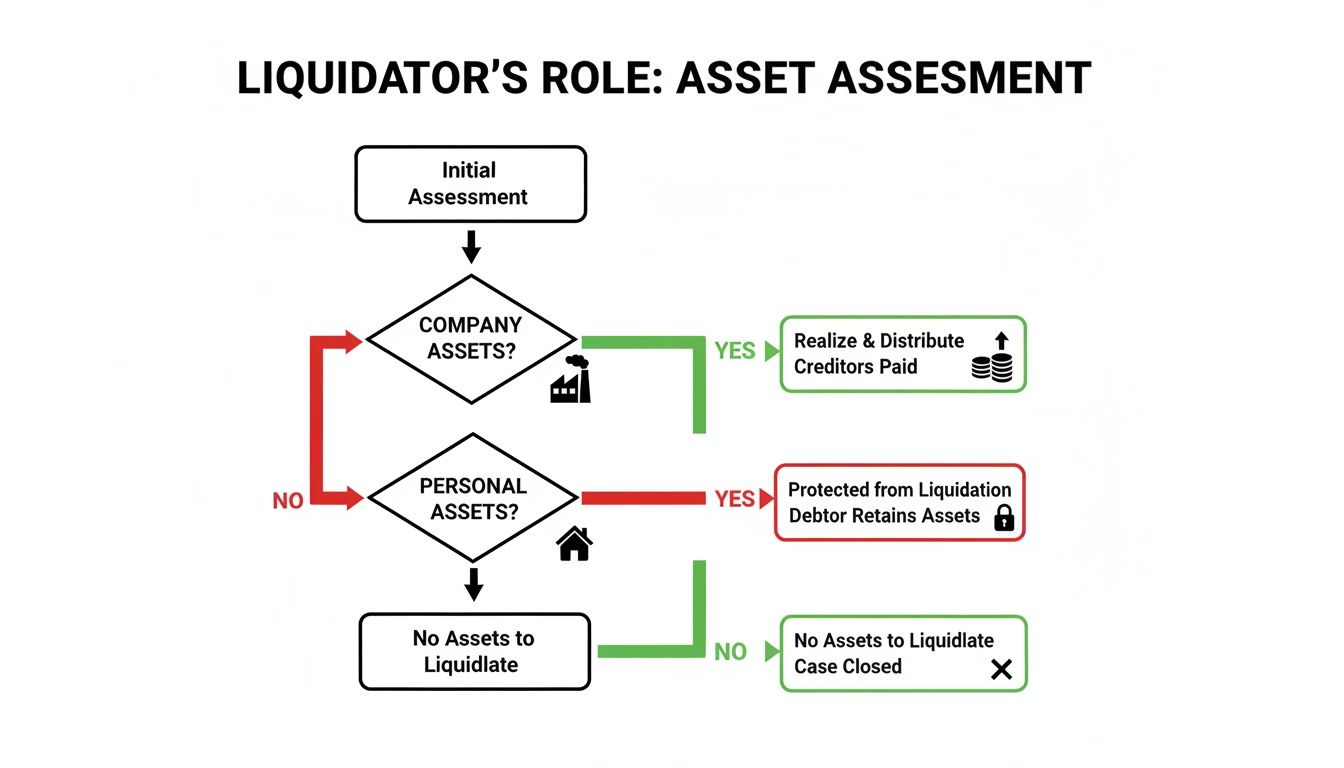
As you can see, their main focus is always on company assets. But actions like personal guarantees or overdrawn loans create a bridge that leads them straight to you.
The Danger of Insolvent Trading
As a director, you have a legal duty to stop racking up new debts when the company is insolvent (meaning, it can't pay its bills as they fall due). If you keep trading and ordering from suppliers or ignoring ATO obligations when you know—or should have known—the company was broke, you're engaging in insolvent trading.
If a liquidator proves you did this, they can make you personally liable for all the debts incurred during that time. This isn't a slap on the wrist; it's a serious breach that can result in a massive personal debt claim against you, putting your house and other assets squarely in the firing line. If you want to know more, it’s worth reading our article on what a liquidator is really looking for when they start digging.
Clawing Back Uncommercial Transactions
When the pressure is on, some directors make desperate moves. A classic example is selling a company asset to a family member or another one of their own entities for a price that's way below its real market value. This is called an uncommercial transaction.
Selling a company car worth $50,000 to your spouse for $5,000 is a huge red flag for a liquidator. They have the power to "claw back," or reverse, these deals. They can either void the sale and take the asset back, or demand the difference in value be paid to the company.
These four situations are the main gateways that expose your personal life to company problems. Facing even one can be a nightmare. A better alternative is to get proactive advice. Instead of waiting for a liquidator to find these issues and put you on the back foot, a pre-insolvency review with LemonAide is designed to spot these weak points first. We can dramatically improve your situation by analysing your entire financial history to find these specific risks, giving you the time and the strategy to deal with them properly before a liquidator is even appointed. It’s about taking control, not just reacting to fear.
The Personal Guarantee Trap That Risks Your Home
Of all the ways your personal life can get tangled up in company problems, one signature on one document stands out as the biggest threat to your home: the personal guarantee. It's a simple act that can have catastrophic results, single-handedly turning a business issue into a personal crisis where you’re left asking, "Can liquidators take my house?"

Think of it as the lender's ultimate safety net. When you applied for that business loan, equipment finance, or even a commercial lease, they almost certainly pushed a guarantee in front of you. By signing it, you made a legally binding promise: if the company can't pay its debts, you will personally. This promise completely bypasses the limited liability protection your company structure is meant to give you, creating a direct line from the company’s creditors to your personal wealth.
At the time, it probably felt like just another hoop to jump through to get the funding you needed to grow. Very few directors truly believe they'll ever be in a position where that guarantee is called in. But when the company's cash flow seizes up, that "formality" suddenly morphs into a very real legal threat aimed squarely at your front door.
What You Signed and What It Means
It’s critical to realise that not all guarantees are the same. The exact wording in that document you signed years ago dictates how much trouble you’re in and how fast a creditor can move against you. There are two main flavours you’ll come across.
An Unsecured Personal Guarantee: This is a general promise to pay up. If the company goes under, the creditor can chase you personally for the outstanding debt. They’ll have to sue you, get a court judgment, and then return to court to get a sequestration order to bankrupt you personally. Whilst it is a process, the bankruptcy trustee may then sell your home.
A Secured Personal Guarantee: This is far more dangerous. In this case, your guarantee is directly tied to a specific asset, and it’s almost always the family home. This means the lender has a registered mortgage or caveat sitting on your property title. If the company defaults, the lender may approach court to get an order for possession and sell your home to get their money back.
The second a personal guarantee is triggered by a creditor, it’s no longer the liquidator’s problem—it’s a direct fight between you and that lender. The bank doesn't care about the liquidation; they just want their money, and your home is the collateral they’ll use to get it.
The Right Way to Structure Your Defence
Instead of making desperate, illegal transfers, the real goal is to create a clear, ethical, and legally defensible wall between your business and personal wealth. This isn't about hiding assets; it's about organising them lawfully. If the business fails, your personal life shouldn't automatically be dragged down with it.
This is where getting specialist pre-insolvency advice is absolutely essential. You need an expert who works for you, not for your creditors or a future liquidator or Bankruptcy Trustee. A far better alternative is to engage an advisor like LemonAide. Our first step is never to suggest hiding anything. Instead, we do a deep dive into your entire financial picture—both business and personal—to get a true read on your position.
We look at things like:
Ownership Structures: Who legally owns the family home? When was it bought? Is it jointly owned, or in one partner’s name?
Existing Liabilities: Have you signed personal guarantees tied to the property? Is there an overdrawn director loan that needs to be sorted out?
Transaction History: Have there been any recent, questionable transfers of assets that a liquidator is going to jump on?
Proactive asset protection is about building a fortress with legal bricks and mortar, not a flimsy tent out of desperation. A liquidator has the power to look back several years to investigate transactions. A last-minute 'gift' of your house to a family member is one of the first things they'll find and overturn.
Building Your Financial Fortress with Expert Guidance
Once we have a complete map of your situation, the LemonAide team can recommend lawful strategies to strengthen your financial position. This will improve your situation by providing a specific plan based on your unique circumstances, not a one-size-fits-all template. The objective is to make sure that any assets you rightfully own are protected within the full bounds of the law.
For instance, dealing with an overdrawn director's loan account before a liquidator gets appointed can stop them from demanding an immediate repayment you can't afford. We might explore ways to properly document and offset the loan, or put a formal repayment plan in place. Likewise, if you've signed a personal guarantee, we can start negotiations with the creditor long before they start making threats of foreclosure.
This proactive approach is the key difference between facing a liquidation with a clear plan and just being a sitting duck. It gives you back some control and helps you prepare for the inevitable scrutiny that's coming. If you're worried about your current setup, getting advice on personal asset structuring can provide immense clarity and peace of mind.
Ultimately, the best way to answer the question, "can a liquidator take my house?" is to have your affairs structured so the answer is a firm, and legally defensible, "no." This is achieved through thoughtful planning and expert guidance, not by reacting with fear.
Why Pre-Insolvency Advice Is Your Strongest Shield
When a company hits rough financial waters, a director really only has two choices. The first is to stick your head in the sand, cross your fingers, and then deal with the fallout when a liquidator eventually comes knocking and starts digging. The second, much smarter path is to get on the front foot and sort out the problems before a liquidator is ever in the picture.
If you’re asking yourself, "can a liquidator take my house?", it’s a red flag that you’re already on that reactive, defensive path. Pre-insolvency advice flips the script entirely. The question changes from a fearful one to a strategic one: "How do I legally and ethically protect my home?" This shift from defence to offence is the heart of what we do at LemonAide. It’s about taking back control when it feels like you've lost it.
The Two Roads a Director Can Take
Think of it like finding a leak in your roof during a storm. The reactive approach is to shove a bucket under the drip and just hope the rain stops. The proactive path? You call a roofer straight away to find the source of the leak and fix it before the whole ceiling caves in. Insolvency is exactly the same.
Waiting for a liquidator to be appointed is like waiting for that ceiling to collapse. They will find the issues—that personal guarantee you signed years ago, the overdrawn director's loan account, the potential insolvent trading claim. Their job isn’t to help you; it’s to claw back as much money as possible for creditors, and that often means coming after you personally if there’s a legal hook.
Engaging a pre-insolvency specialist like LemonAide is the better alternative; it's like calling the roofer. We work for you, not for the creditors. Our entire focus is on finding the leaks in your financial structure and helping you patch them up legally, which dramatically improves your situation by securing your assets and giving you some desperately needed peace of mind.
How LemonAide Becomes Your Shield
Our process is designed to give you clarity and put you in a position of strength. We don't hand out generic, one-size-fits-all advice. We deliver a clear, actionable game plan that’s built specifically for your situation. Here’s how we get you protected:
The Initial Chat: We start with a free, no-obligation discussion to get a complete handle on your situation—both the business and your personal life. This lets us see the whole board, including your assets, debts, and all the potential tripwires.
Risk Mapping: Our team then does a deep dive to pinpoint every single vulnerability. We go through personal guarantees with a fine-tooth comb, analyse director loan accounts, and flag any transactions a liquidator would likely try to claw back.
Your Custom Strategy: From there, we build a clear, written strategy that lays out the practical steps you can take to protect your family home and other personal assets. This isn't about illegally hiding things; it's about lawful restructuring and smart negotiation to fortify your position before the battle begins.
By getting on the front foot, we help you manage the very risks that could give a liquidator the power to move against your personal property. We give you the expert guidance and advocacy you need to get through this incredibly stressful time, working towards a future where your home is safe and secure.
We've gone through the main ways your home can get tangled up in a company liquidation, but I know you've probably got more specific questions playing on your mind. Let’s tackle some of the most common ones I hear from directors.
My House Is in My Spouse's Name. Is It Safe?
On the surface, yes. If your spouse is the sole owner and they haven’t signed any personal guarantees for the business, the property is generally protected.
However, a liquidator will absolutely dig into when and how the house was put solely in their name. If you transferred your share over to them recently, knowing the company was in trouble, a liquidator will see that as a deliberate move to dodge creditors. They can, and often will pursue you into Bankruptcy, where the Bankruptcy Trustee may challenge this transaction as a voidable transaction and have it reversed.
This is exactly why getting confidential advice from a service like LemonAide before a liquidator is appointed is so critical. It's a much better alternative to guesswork. We can look at the history of the property and its ownership structure to tell you where you genuinely stand, which will greatly improve your situation.
What's the Difference Between Liquidation and Bankruptcy?
It’s simple: liquidation is for companies, and bankruptcy is for people.
Liquidation is the formal process of winding up a company. A liquidator sells the company's assets to pay its debts.
Bankruptcy is the legal process for an individual who can't pay their personal debts.
The real danger is when a company liquidation triggers a director's personal bankruptcy. This happens all the time when a director is called on to pay a personal guarantee they simply can't afford. The entire purpose of getting pre-insolvency advice from a service like LemonAide is to improve your situation by navigating the company's problems without it blowing up into a personal financial disaster for you.
Can I Sell My House Before the Company Goes into Liquidation?
Yes, you're free to sell your personal assets. The crucial part isn't the sale itself, but what you do with the money. If you use the cash for normal living expenses or to pay down other personal debts (like the mortgage on the house you just sold), that’s usually fine.
The problem arises if you use those funds in a way that looks like you're trying to cheat your company's creditors. For instance, lending the money back to the failing company or giving it to a family member could be scrutinised heavily. Before you make any major financial moves under pressure, getting a confidential second opinion from a specialist like LemonAide is the only safe way to play it and is a much better alternative to taking a risky guess.
Does a Liquidator Look at My Personal Bank Accounts?
A liquidator’s job is to focus on the company's financial affairs, so they don’t have an automatic right to go rifling through your personal bank accounts.
However, if their investigation into the company’s books uncovers suspicious payments from the business to you, or suggests company money was used for personal expenses, they won't hesitate to seek legal orders to examine your accounts. They are looking for reasons to sue you, and your bank statements can give them the ammunition they need. Proactively managing this with a service like LemonAide is a better alternative than waiting to be investigated.
Trying to figure all this out on your own is a recipe for stress and, frankly, bad decisions. The only way to get real peace of mind and properly protect your home is to get expert advice that is 100% on your side.
The team at LemonAide works for you—not your creditors. We build a clear, legal, and ethical strategy to keep your assets safe. Using our service will improve your situation by providing clarity and a path forward. Find out where you really stand by visiting https://www.lemonaide.com.au to book a free, confidential chat.