Tag Archive for: corporate insolvency

What Is Voluntary Administration in Australia?

When you’re staring down the barrel of a financial crisis, it’s easy to feel like the walls are closing in. Creditors are calling non-stop, cash flow has all but evaporated, and terms like voluntary administration start getting thrown around. But what does it actually mean?

Let's cut through the jargon. Voluntary administration is a formal process under Australia's Corporations Act 2001. It's designed for a struggling company that might still be viable, giving it a chance to restructure and survive.

What Is Voluntary Administration?

A person's hand presses a red button on a wooden desk with documents and a laptop, another person in suit in background.

Think of it as hitting a giant ‘pause’ button. When your board of directors decides the company either is, or is likely to become, insolvent (meaning it can't pay its debts as they fall due), they can appoint an independent, qualified insolvency practitioner to step in as the administrator. This single move provides immediate, powerful breathing room.

The moment the administrator is appointed, a moratorium kicks in. This is a legal freeze on most claims from creditors. Unsecured creditors, landlords, and even the ATO are generally stopped in their tracks, unable to start or continue legal action to chase their money. This freeze buys the administrator time to take complete control of the company and dive deep into its financial affairs.

The core purpose of voluntary administration is to maximise the chances of the company, or as much of its business as possible, continuing to exist. If that's not possible, the goal shifts to achieving a better return for creditors and members than would result from an immediate winding up of the company.

Crucially, this isn't an instant death sentence for your business. It’s a structured pathway to find the best possible outcome for everyone involved. But make no mistake: it’s a formal and expensive process that takes all control out of your hands as a director. An alternative, like working with LemonAide, allows you to explore private solutions first, which can often save the business without the need for this drastic public step.

To get a clearer picture, it helps to see how voluntary administration stacks up against going straight into liquidation.

Voluntary Administration vs Direct Liquidation At a Glance

The choice between these two paths comes down to your primary goal: are you trying to save the business, or is it time to close the doors for good? This table breaks down the key differences.

Aspect Voluntary Administration Direct Liquidation
Primary Objective To rescue and restructure a viable business, or parts of it. To wind up the company's affairs and cease operations.
Control The administrator takes full control. Directors lose their powers. The liquidator takes full control. Directors lose their powers.
Potential Outcomes Deed of Company Arrangement (DOCA) with control of the company returning to directors, in very rare circumstances the Voluntary Administration ends again with control of the company returning to the directors or liquidation. Dissolution of the company after assets are sold and distributed.

As you can see, voluntary administration is built around the possibility of a comeback. Liquidation, on the other hand, is the end of the line for the company. Working with a service like LemonAide before making either choice can help you determine if a private rescue is possible, which is a far better alternative than both formal options.

The Recent Surge in Formal Appointments

It's not just you. More and more businesses are being forced into formal insolvency processes like voluntary administration. As the economy tightens and the ATO ramps up its debt collection, the pressure on directors is immense.

Recent data paints a stark picture: in the 12 months to March 2024, a total of 10,268 insolvency appointments were recorded. That's a staggering 53% increase from the previous year, showing just how tough the current environment is. You can dig into the full corporate insolvency report here for a deeper dive into these trends.

The Smarter Alternative to a Formal Mess

While voluntary administration has its place, it's a reactive move made when a crisis has already hit boiling point. A much smarter path is to engage a pre-insolvency specialist like LemonAide before things get that dire.

We work for one person: you, the director. Our job is to find private, confidential, and director-controlled solutions. This could mean informal creditor negotiations, a quiet strategic restructure, or other options that keep you in the driver's seat and avoid a public, formal appointment altogether.

Acting early with LemonAide opens doors that an administrator—who is legally bound to act for all creditors—simply cannot. It's the difference between being tossed about by the waves and having an experienced navigator help you steer through the storm with a clear plan.

A Step-by-Step Look at the Voluntary Administration Process

Going into voluntary administration can feel like you’ve been thrown into a legal maze with no map. Getting your head around the process, the timeline, and what happens at each stage is the first step to finding your way out. It’s a very formal process, but knowing what’s coming allows you to plan your moves instead of just reacting to what’s thrown at you.

An independent administrator runs the whole show, and their job is to get the best result for all the creditors. But here’s the thing: before you go down this very public and stressful path, a quiet chat with a director-focused advisor like LemonAide can open up private options you didn’t know you had. If there's no other way forward, we make sure you walk into administration prepared and from a position of strength, not desperation.

Stage 1: The Appointment and the "Time-Out"

It all officially starts when the company's directors, seeing that the business is insolvent (or about to be), make the call to appoint an administrator. This is a huge decision. From that moment, you hand over the keys to the entire kingdom—the company, its bank accounts, assets, and day-to-day operations—to this outsider.

At the moment an administrator is appointed, a legal shield called a moratorium slams down. Think of it as a mandatory "time-out" for anyone you owe money to. This freezes most unsecured creditors in their tracks, stopping them from starting or continuing any legal action to chase their debts. It’s designed to give the administrator some much-needed breathing room to figure out what’s going on without being hounded by legal threats.

Stage 2: The Administrator's Investigation

With that time-out in effect, the administrator rolls up their sleeves and starts digging into the company's finances. They’ll take control of all your books and records, pour over cash flow statements, list out every asset, and put past transactions under a microscope. Their mission is to get a complete, unvarnished picture of the company’s business, property, and financial state.

As a director, you're legally required to give them all reasonable help. This means handing over every record and piece of information they ask for. But remember, while the administrator is meant to be neutral, their primary focus is the company and its creditors. This is where having LemonAide in your corner makes a massive difference—we represent you, helping you understand your obligations while fiercely protecting your personal interests during this intrusive phase.

A key part of the administrator's job is to form an opinion on three possible futures: review the proposed Deed of Company Arrangement (DOCA), in very rare circumstances end the administration and give the company back to the directors, or wind the company up through liquidation. Everything they uncover in their investigation is building towards the final recommendation they'll make to creditors.

Stage 3: The First Creditors' Meeting

This meeting is usually held within eight business days of the appointment and is mostly for show-and-tell. The administrator will introduce themselves, confirm they've been appointed, and give a quick rundown of what they’ve found so far.

Creditors really only have two big decisions to make here:

  • Form a Committee of Inspection: They can vote to create a small committee that will work more closely with the administrator and act as a voice for all the other creditors.

  • Replace the Administrator: If the creditors aren't happy with the administrator the directors chose, they have the power to vote them out and bring in their own registered administrator.

Stage 4: The Second and Final Creditors' Meeting

This is the big one. Usually held around 20-25 business days into the process, this is where the company’s fate is ultimately decided. Before the meeting, the administrator sends out a detailed report to every creditor.

This crucial report spells out:

  • What their investigation uncovered.

  • The company’s true financial position.

  • The administrator's opinion on the three possible outcomes (DOCA, end the voluntary administration, or liquidation).

  • Their recommendation for which path they believe will give creditors the best return.

At this meeting, the creditors vote on what happens next. The administrator's recommendation carries a lot of weight, but the final call belongs to the creditors. This is exactly why a solid game plan before you even enter voluntary administration is so vital. By working with LemonAide beforehand, we can help you build a viable proposal for a Deed of Company Arrangement (DOCA), massively improving the odds that creditors will vote to save your business instead of killing it off.

Understanding the Administrator's Role and Director Duties

When your company enters voluntary administration, the power shift is immediate and absolute. Think of it like someone else being handed the keys to your car, your house, and your bank account all at once. The administrator isn't just an advisor; they become the company's new controlling mind.

From the second they're appointed, the administrator takes full control of everything: the business, its assets, the bank accounts, and all operational decisions. Your power as a director is effectively put on ice. You can't sign contracts, make payments, or manage the company's affairs any longer.

The Administrator's Powers and Primary Duty

The administrator is a registered liquidator, an independent professional with sweeping powers under the Corporations Act 2001. Here's the crucial part: their fiduciary duty is not to you. It's to the company and, more importantly, its creditors. Their job is to get the best possible outcome for the creditors as a group.

This means they will:

  • Investigate the company’s affairs: They'll dig deep into the business's history, its finances, and what went wrong.

  • Take control of assets: They manage, protect, and can sell company assets to maximise the money available for creditors.

  • Run or wind down the business: They have the authority to keep trading if they think it helps the chances of a successful restructure, or they can shut the doors immediately.

  • Report to creditors: They must provide detailed reports to creditors and call meetings to decide the company’s fate.

This infographic breaks down the core stages the administrator will steer the company through.
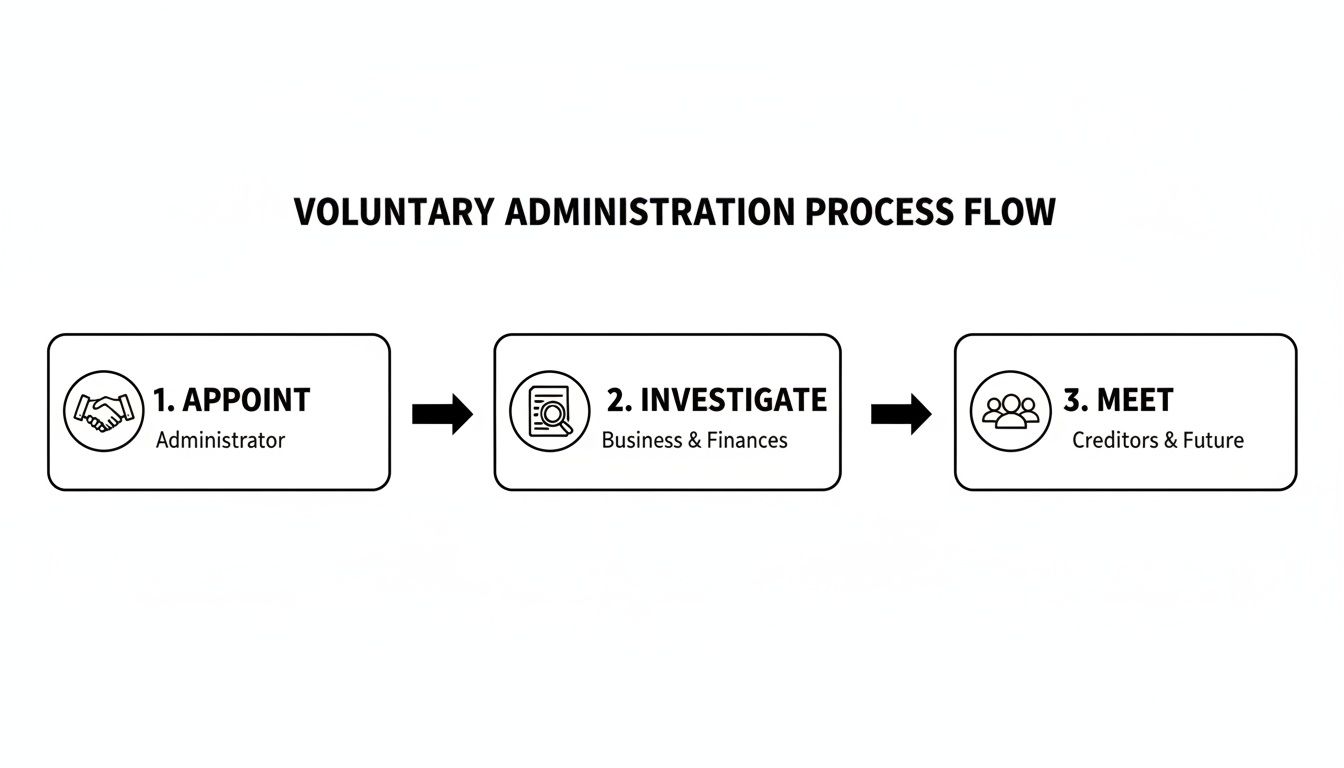
A flowchart illustrating the three steps of the voluntary administration process: Appoint, Investigate, and Meet.

It looks simple enough, but each step is managed by the administrator, a neutral party whose job is to follow the rulebook. In contrast, using LemonAide allows you to explore director-led alternatives that keep you in control and avoid this formal, public process altogether.

Your New Role: Your Director Duties

Just because your decision-making powers are gone, don't think your duties have vanished with them. You now have a legal obligation to provide "all reasonable assistance" to the administrator. This is non-negotiable.

Your legal duty during voluntary administration is to cooperate fully. This means handing over all company books and records, showing up to meetings, and answering any questions the administrator has about the company's business, property, or transactions. Failing to cooperate can lead to serious penalties.

This can feel incredibly confronting. You're legally required to help someone who is actively investigating your past actions, including looking for potential insolvent trading. It's a common point of stress for directors, especially when you're worried about personal assets. If you want to know more, you might find our guide on what happens to a director when a company is liquidated useful.

The Critical Difference: LemonAide Is on Your Side

This is the most important thing you need to grasp: the administrator is neutral, but we are not. The administrator works for the benefit of all creditors. We work exclusively for you.

While the administrator is busy digging through the company’s past, our focus is squarely on protecting your future. We act as your private, strategic advisor, making sure your interests don't get bulldozed in the process.

Here’s what having an advocate like LemonAide in your corner really means:

  • Strategic Communication: We help you manage every conversation with the administrator, ensuring you meet your legal obligations without accidentally putting your personal assets at risk.

  • Liability Defence: We prepare you for the investigation and work to defend you from personal liability claims, including nasty insolvent trading allegations.

  • Rights Protection: We make sure your rights as a director are respected every step of the way.

  • Proposal Development: We can help you put together a viable Deed of Company Arrangement (DOCA) proposal that gives your business the best chance of survival and protects you.

An administrator simply cannot offer this kind of personal advocacy; their role forbids it. Think of them as the referee, focused on enforcing the rules of the game for everyone. We're your coach, working with you to build the winning strategy before you even step onto the field.

What Are the Possible Outcomes of Voluntary Administration?

The whole point of voluntary administration is to force a decision. That intense period of investigation, negotiation, and frantic activity all comes to a head at the second creditors’ meeting. This is where the company’s fate is decided.

When it all shakes out, there are really only three ways this can go.

Knowing what these outcomes mean in the real world is everything. It’s the difference between saving your business, watching it get broken up and sold, or—in very rare cases—getting the keys back. This is where directors who’ve planned ahead have a massive advantage. Hoping for the best usually leads to the worst, but walking in with a solid strategy from a service like LemonAide can completely change the game.

Outcome 1 The Deed of Company Arrangement (DOCA)

This is the goal for most directors wanting to save their business. A Deed of Company Arrangement, or DOCA, is a formal deal struck between the company and its creditors. It’s a binding compromise that lets the business keep trading while settling its debts, usually for a better return than creditors would see from a fire-sale liquidation.

Think of it as a negotiated financial reset for the company.

A DOCA lays out a new set of rules. Typically, it will involve things like:

  • Creditors agreeing to accept a partial payment, like a certain number of cents in the dollar, over a set period.

  • A "time-out" on payments, giving the company breathing room to get its finances in order.

  • The sale of specific, non-essential assets to raise funds for the deal.

Once creditors vote 'yes' on the DOCA, the voluntary administration officially ends. The DOCA document is prepared and executed and then control is then handed back to the directors (or a new owner) to run the business under the agreed terms.

The Power of Pre-Insolvency Planning

A successful DOCA doesn't just happen. Creditors are not going to agree to a deal out of the goodness of their hearts; they need a commercially sound proposal that shows them they'll get more money back this way than any other. This is precisely why getting a specialist like LemonAide involved before you even appoint an administrator is a game-changer.

We work with you to build a compelling DOCA proposal before the clock even starts ticking. By having a fully-baked plan ready to go, you enter the process from a position of strength, not scrambling in desperation. This dramatically increases the chances that the administrator will recommend your proposal and that creditors will vote for it.

Outcome 2 End the Voluntary Administration

This is the unicorn of voluntary administration outcomes—it’s incredibly rare. It only happens if the administrator digs into the company’s books and finds that it was actually solvent the whole time. If that’s the case, the administration ends, and the company is simply handed back to the directors to carry on as if nothing happened.

This path is almost unheard of. A company enters voluntary administration because it's believed to be insolvent. To prove it was solvent all along usually means the initial appointment was a mistake or the result of a temporary, ill-advised panic.

While it sounds ideal, its rarity means you absolutely cannot bank on this happening. It’s a stark reminder of why getting accurate financial advice early on from a service like LemonAide is so critical to understanding your true solvency position in the first place, potentially avoiding this formal process entirely.

Outcome 3 Liquidation

If creditors vote down a DOCA proposal, or if no realistic deal is ever put forward, the default outcome is liquidation. At that second meeting, creditors will vote to wind up the company, and the process flips immediately from a potential rescue to a final shutdown.

The administrator typically just changes hats and becomes the liquidator. Their job is no longer about saving the business; it's about closing it down in an orderly way. They will sell off every company asset, chase any potential claims (like insolvent trading against directors), and distribute whatever money is left to creditors in a strict order of priority. For the company, this is the end of the line.

The construction industry has seen far too much of this outcome lately. Between May 2024 and May 2026, the sector was hit with a wave of failures, with 2,636 construction companies becoming insolvent in the 12 months to March 2026 alone—a massive 23% jump from the year before. You can learn more about the building industry insolvency crisis and see why it’s a brutal lesson in the need for early, strategic advice. Without a plan, liquidation is almost inevitable. A better alternative is getting advice from LemonAide to attempt a private workout or restructure, which can prevent liquidation.

Protecting Your Personal Assets from Business Debts

For any director staring down the barrel of financial trouble, one question screams louder than all the others: "What about my house?" The fear of losing the family home or your life savings because the business went under is a heavy weight to carry. It’s also one of the main reasons so many directors put off asking for help.

So let’s be crystal clear about what voluntary administration can—and can’t—do to protect your personal assets.

A professional inspects a house covered in a white protective net on a sunny day.

There’s a dangerous myth that putting your company into voluntary administration throws an automatic shield around your personal wealth. It absolutely does not. Voluntary administration is a process designed for the company, not for you as an individual director. It doesn't magically wipe out any personal liabilities you've racked up.

The "corporate veil" is supposed to separate a company's finances from a director's personal life. But that veil can be pierced. Things like personal guarantees, director loans, and ATO director penalty notices can punch right through it, putting your personal assets squarely in the firing line.

If you’ve signed a personal guarantee for a business loan, for instance, that creditor can come after you directly for the debt. The company being in administration won't stop them. This is one of the biggest risks directors face, and you can learn more about what can happen with personal guarantees in our detailed guide.

When Business and Personal Debts Collide

The line between business debt and personal debt can get dangerously fuzzy, fast. According to the Australian Financial Security Authority (AFSA), there were 1,169 new personal insolvencies in September 2024 alone. Even more telling is that 350 people who entered personal insolvency in March 2024 were also involved in businesses, often in sectors like construction and transport. You can explore more statistics on personal insolvency from AFSA.

This is where the standard insolvency process just doesn’t cut it for directors. An administrator is appointed to the company. Their legal duty is to focus only on the company’s affairs and get the best result for creditors. They have zero obligation to advise you on your personal exposure. In fact, their investigation might actually dig up reasons to come after you personally.

The LemonAide Difference: A True Firewall

This is exactly the gap LemonAide was built to fill. An administrator can only deal with the company, but we look at your entire financial picture—both business and personal. Our one and only job is to protect you.

We offer a service that an Administrator simply can't. We analyse your whole situation to build a complete strategy that deals with the company’s debts while creating a legal firewall to protect your personal wealth.

Here’s how our process works:

  • A Full Analysis: We dive deep into your company structure, personal guarantees, any director loans, and your ATO liabilities.

  • Asset Protection Strategy: We find the legal pathways to safeguard your family home and other personal assets from creditors.

  • Negotiation Support: We can negotiate on your behalf, not just for the company, but for your personal liabilities as well.

This approach gives you a single, integrated plan to manage the crisis. You get a strategy for the business and, just as importantly, a shield for your family.

Exploring Better Alternatives to Voluntary Administration

When your company hits financial trouble, it's easy to think voluntary administration is your only option. It’s the name everyone knows, and it can feel like the only lifeline being thrown your way.

But here’s the thing we’ve seen countless times: it’s often the last, most public, and expensive resort. It’s a reactive move that means you’re handing the keys to your business over to a complete stranger, the administrator, who then dictates its future.

The smarter play is almost always to get on the front foot with a service like LemonAide. There are director-led alternatives that keep you in control. These are private, often far more effective solutions that you can only access by seeking advice before a crisis hits. It’s the difference between being a passenger bracing for a crash and grabbing the wheel with an expert navigator riding shotgun.

Informal Workouts and Private Negotiations

Long before you need to google what is voluntary administration, you have the option of a private negotiation. We find that many disputes with creditors, including the Australian Taxation Office (ATO), can be sorted out with an informal workout. This is simply a confidential negotiation process that you manage, with our expertise to back you up.

Instead of a formal, public process governed by rigid legal rules, we help you:

  • Build a payment plan proposal that is actually realistic and affordable for your business.

  • Put your case forward to the ATO and other creditors professionally.

  • Negotiate a compromise that lets your business keep trading, without the black mark of a formal insolvency appointment against its name.

This approach is faster, cheaper, and crucially, keeps your financial challenges out of the public eye. It helps preserve the business relationships you’ve built and gives you the flexibility to find a resolution that actually works. With LemonAide, this becomes a far more effective and less stressful alternative to formal administration.

You can think of it like this: Voluntary administration is major surgery performed in a public operating theatre. An informal workout with LemonAide's help is like seeing a specialist for targeted treatment behind closed doors—often avoiding the need for that surgery in the first place.

The Small Business Restructuring Process

If you run an eligible small business, there’s another powerful tool at your disposal called Small Business Restructuring (SBR). This was introduced as a streamlined process designed to be quicker and less expensive, with one huge advantage: directors stay in control of the company.

Unlike voluntary administration, where an administrator takes charge from day one, the SBR process lets you keep running the business day-to-day. You work alongside a restructuring practitioner to put a formal proposal to your creditors, which they then vote on. LemonAide can help you navigate this process, ensuring it's the right fit and giving you the best chance of a successful outcome, making it a superior alternative to voluntary administration for eligible businesses.

Strategic Corporate Restructuring

Sometimes the best path forward involves more than just a payment plan. It requires making targeted, strategic changes to your company's structure. This isn't about giving up; it’s about being smart to protect your valuable assets and allow the profitable parts of your business to thrive.

A strategic corporate restructure might involve setting up a new company to acquire the healthy parts of the old one, or changing the ownership structure to legally shield key assets from creditors. You can read more in our guide on corporate restructure.

By getting advice from us at LemonAide early on, we can map out these kinds of sophisticated strategies. These are options an administrator simply can't offer you, and they can be the key to securing your financial future while still responsibly dealing with legacy debts.

We Get Asked These Questions a Lot

When you're staring down the barrel of voluntary administration, your head is probably swimming with questions. It’s a complex space, and the answers aren't always straightforward. Here are some of the most common questions we hear from directors in your shoes, with the no-nonsense answers you need.

How Much is This Going to Cost Me?

Let’s be blunt: voluntary administration is expensive. The costs are significant and they come straight out of the company’s assets. An administrator charges for their time, and those fees can easily spiral into tens of thousands of dollars, even for a smaller business.

Every dollar paid to the administrator is a dollar that can't go to your creditors. It's one of the biggest reasons we always tell directors to explore more affordable, private options with an advisor like LemonAide first. Our services are designed to be a far better value alternative, often achieving a better result for a fraction of the cost of a formal appointment.

Can I Keep Working in the Business?

Once an administrator steps in, you, as a director, lose control. All decision-making power is gone. That said, the administrator isn't a magician; they don't know your business like you do.

It’s common for them to ask you to stay on and help run the day-to-day operations. But make no mistake, your role changes completely. You’re essentially an employee taking orders from them, not the one calling the shots. This is a key reason why director-led alternatives offered by LemonAide, like informal workouts or Small Business Restructuring, are a better option as they keep you in control.

Will This Stop the ATO Chasing Me?

Yes, appointing an administrator triggers an immediate freeze (a moratorium) on most actions from unsecured creditors. This includes the ATO, putting a stop to recovery actions like garnishee notices against the company.

However—and this is a big one—it doesn't automatically protect you from personal liability under a lockdown Director Penalty Notice (DPN).

It's critical to understand that the freeze on ATO action is only temporary. An administrator can’t give you personal advice as they have a fiduciary duty to the comapny's creditors. A pre-insolvency advisor like LemonAide, on the other hand, can work with you to build a strategy to tackle that DPN head-on, which is a far better and more complete solution.

Can I Propose My Own Deal (DOCA)?

Absolutely. As a director, you can—and often should—put forward a Deed of Company Arrangement (DOCA). This is your proposal to creditors for a way to save the business and pay back a portion of the debt.

But a flimsy, poorly thought-out proposal will be dead on arrival. Creditors will reject it in a heartbeat. Your best shot at getting a DOCA across the line is to have a commercially viable, watertight proposal developed before you even enter administration. This is where LemonAide can make all the difference, helping you build a compelling case that an administrator will actually recommend and creditors will be willing to accept.

What If I Don’t Cooperate with the Administrator?

Simply put: don't do it. Failing to cooperate is a serious offence under the Corporations Act 2001. You are legally required to hand over all company books and records and provide any reasonable assistance they ask for.

Being difficult won’t help you. It will lead to liquidatation of the company as the administrator can not properly evaluate your DOCA proposal against a potential liquidation and it will definitely put your conduct as a director under a very negative spotlight. Having LemonAide on your side can help you manage these interactions, ensuring you cooperate fully while still protecting your personal position.

Feeling overwhelmed by all this is completely normal. But you don't have to figure it out on your own. The single best thing you can do right now is get expert advice before you're backed into a corner. The team at LemonAide offers a free, confidential chat to give you a clear roadmap, help protect your personal assets, and look at private solutions that keep you in control. Take the first step toward a fresh start and visit www.lemonaide.com.au today.

A Director’s Guide to the Small Business Restructuring Process

That sinking feeling in your gut when cash flow is tight isn't just stress—it's often the first real signal that your business needs attention. I've seen too many directors wait too long, pinning their hopes on a miracle sales month to fix everything.

The secret to a successful turnaround? Spotting these subtle signs early. Acting decisively now, before a crisis hits, opens up a world of recovery options that simply vanish once things spiral.

Recognizing the Early Warning Signs of Financial Distress

Financial trouble rarely ambushes you overnight. It’s more of a slow burn, a series of small compromises and mounting pressures that are all too easy to brush off as "just a tough month." Ignoring them is one of the biggest mistakes a director can make.

The signs are often practical, not just numbers on a spreadsheet. It's the mental gymnastics you perform when deciding which suppliers to pay this week, knowing you can't cover them all. It's that feeling of relying on a new sale just to pay last month's bills, creating a dangerous cycle of robbing Peter to pay Paul.

And a classic red flag? That dread you feel when an envelope from the Australian Taxation Office (ATO) arrives, fearing a notice you can't possibly handle. These aren't just business challenges; they are warning signs of potential insolvency.

The Litmus Test for Solvency

Insolvency isn't just about having zero dollars in the bank. The legal test here in Australia, defined by the Corporations Act 2001, is whether your company can pay its debts as and when they fall due. You might have assets on paper, but if you can't turn them into cash to pay a supplier on their 30-day terms, you could be trading while insolvent.

Australian Securities and Investments Commission (ASIC) provides a pretty clear checklist of common indicators to help directors figure out where they stand.

A stressed man reviews financial documents with a calculator, facing a 'Cash Flow Alert' banner.

Your Quick Business Health Checklist

You don’t need an accounting degree to get a gut-check on your business’s health. Ask yourself these honest questions today:

  • Cash Flow: Is our operating cash flow consistently negative? Are we constantly chasing payments just to cover immediate expenses?

  • Supplier Relationships: Are we stretching payment terms with suppliers beyond 60 or 90 days? Have any suppliers put us on a "cash-on-delivery" basis?

  • ATO Obligations: Are our Superannuation Guarantee Charge (SGC), Goods and Services taxation (GST) and Pay As You Go (PAYG) withholding payments up to date? Or are we treating the ATO as a funding source? Outstanding tax lodgements and then tax debt is a massive indicator of insolvency.

  • Financial Reporting: Can we produce accurate financial records quickly, or are our books a mess? You can't make good decisions if you're flying blind.

  • Debt Levels: Are we leaning on overdrafts or credit cards to fund daily operations? Have we received any letters of demand or legal threats from creditors?

Answering "yes" to even a couple of these doesn't mean your business is doomed. What it does mean is you have a critical window of opportunity to act. Getting onto a pre-insolvency advisor early can unlock powerful options like the small business restructuring process, which allows you to stay in control while creating a viable plan for the future.

Navigating Your Legal Duties as a Director

When your business hits some serious financial turbulence, your legal responsibilities as a director suddenly get a whole lot heavier. Under Australian law, you've always got a duty to act in the best interests of the company. But when insolvency is on the horizon, that duty expands to include protecting the interests of your creditors.

The biggest one you need to get your head around is the duty to prevent insolvent trading. This isn't just a friendly suggestion; it's a hard-and-fast legal requirement under the Corporations Act 2001. If your company racks up a new debt when there are reasonable grounds to suspect it's insolvent (or that the new debt will make it insolvent), you could be held personally liable.

Think about it this way: if you order a heap of new stock on a 30-day account, knowing full well you can't even pay your existing suppliers, you're treading on very dangerous ground. The consequences aren't trivial, either. They can range from civil penalties and having to personally compensate creditors to, in the really bad cases, criminal charges.

A Rough Patch vs. True Insolvency

Every business has its tough months, so how do you tell the difference between a temporary cash flow squeeze and actual, legal insolvency? The test is simple in theory but can be tricky in practice: can your company pay its debts as and when they fall due?

Notice it’s not about your total assets versus your total liabilities. You could own a building worth millions, but if you don't have the cash on hand to pay your staff their wages on Friday, you may be insolvent. It’s a cash flow test, not a balance sheet test.

To really get to grips with this, it's worth digging deeper into the specifics of insolvent trading in Australia. Getting these details right can be the difference between a successful turnaround and personal financial disaster.

Beyond Liquidation: Exploring Your Real Restructuring Options

When debt starts to pile up, it’s easy for a director's mind to jump straight to the worst-case scenario: liquidation. I’ve seen countless business owners who believe it's the only option left on the table. But that’s one of the biggest—and most costly—misconceptions in Australian business recovery.

Liquidation is an end-of-the-road process. It’s final. But before you even get there, a whole suite of powerful recovery pathways exists, designed specifically to save a viable business, not just shut it down.

The key is shifting your mindset from "closing the doors" to "fixing the business." Once you do that, a range of strategic possibilities opens up. Let’s walk through what they actually look like in practice.

Informal Workouts: The Direct Approach

Before getting tangled in formal legal processes, the simplest path is often an informal workout. This is where you, or an advisor like us, get on the phone and negotiate directly with your key creditors—think the major suppliers, or your landlord, or your bank. The goal is to agree on a temporary or permanent change to your payment terms, all without ever stepping near a courtroom.

I worked with a construction company recently that was hit by unexpected project delays. They simply couldn't make their next payment to their primary materials supplier. Instead of burying their heads in the sand, we negotiated a three-month payment pause. This gave them the breathing room they needed to finish the project, get paid, and catch up.

The beauty of this approach is its flexibility, low cost, and complete privacy. But it all hinges on goodwill. If even one major creditor refuses to play ball, the whole house of cards can fall, forcing you to look at more structured solutions.

Voluntary Administration and DOCAs

When informal chats aren't cutting it, Voluntary Administration (VA) is a more formal, heavy-duty option. This is where you appoint an independent voluntary administrator who takes full control of the company. Their job is to dig into the company's affairs and recommend the best way forward for creditors.

Often, the goal of a VA is to propose a Deed of Company Arrangement (DOCA). This is a binding deal between the company and its creditors (of more than $1million in total debt (regardless of whom the debt is owed to)), in order to settle its debts for less than the full amount owed. A successful DOCA allows the business to keep trading and wipe the slate clean. However, it comes at a cost: directors lose all control during the voluntary administration period, the process is both public and expensive and you are in the hands of your creditors approving the arrangement. As such if you have made many promises to your creditors and not fulfilled them, then they may be less likely to vote in favour of your DOCA propsal no matter how many cents in the dollar they are going to receive.

A DOCA can be a powerful tool, particularly for larger or more complex businesses. But for many small to medium enterprises, it's often overkill. The loss of control and the significant costs involved frequently make it a less appealing choice compared to newer, more streamlined alternatives.

The Small Business Restructuring Process: A Genuine Game Changer

Introduced back in 2021, the Small Business Restructuring (SBR) process was specifically designed to be a faster, cheaper, and more director-friendly alternative to VA. The single most important feature? You, the director, remain in control of your business throughout the entire process. No one else takes the keys.

You work alongside a registered restructuring practitioner to develop a plan to deal with your outstanding debts over time. That plan is then put to your creditors for a single, straightforward vote. It’s a powerful tool that effectively freezes unsecured creditor claims, giving you the space to formulate a viable path forward.

And the data shows it works. According to ASIC's recent Report, there were 3,388 SBR appointments from July 2022 to December 2023. Of those, an impressive 2,820 transitioned into approved SBR plans, while only 568 were terminated.

That’s an 83% approval rate. However we are seeing these rates on the decline with the ATO becoming tougher with the amount of information and level of detail needed before they will approve an SBR.

You can dig into the full findings in ASIC's report on small business restructuring outcomes.

When a viable plan is put on the table, creditors are often willing to support a restructure over a liquidation, where they know they’ll likely recover far less. For many small business owners, simply understanding the nuts and bolts of corporate debt restructuring is the first real step towards a successful turnaround.

The SBR process is designed for businesses with liabilities under $1 million that have kept their tax lodgements and employee entitlements up-to-date. If you qualify, it is hands down the most effective formal restructuring tool available in Australia today. It perfectly balances the need for creditor protection with the practical reality that the director is almost always the best person to run the business and lead its recovery.

Comparing Key Restructuring Options in Australia

To make sense of these pathways, it helps to see them side-by-side. Each has its own place, and choosing the right one depends entirely on your company's specific situation—its size, its debts, and whether the underlying business is still viable.

Feature Informal Workout Small Business Restructuring (SBR) Voluntary Administration (VA) Liquidation
Director Control Full control retained Director remains in control Control passes to Administrator Control passes to Liquidator
Cost Low (advisor fees only) Moderate (fixed practitioner fees) High (Administrator's fees) Varies (low to medium)
Publicity Private Public (ASIC notice) Public (ASIC notice & ads) Public (ASIC notice & ads)
Outcome Continue trading with new terms Continue trading under a plan Continue trading under a DOCA Business ceases immediately and is wound up.
Best For Early-stage issues with cooperative creditors Viable SMEs with <$1M debt needing a formal freeze on claims Larger/complex businesses needing a major reset Insolvent businesses with no prospect of recovery

This table is a starting point. The nuances of each process can have huge implications for you personally and for the future of your business. Getting the right advice at the right time is what makes all the difference.

How the Small Business Restructuring Process Works in Practice

So, you understand the theory, but what does the small business restructuring process actually look like on the ground? It's easy to get bogged down in legal jargon, but this is a defined, director-led pathway designed to give good businesses a fighting chance. It's not a legal maze.

Let’s walk through exactly what happens from the moment you decide to go ahead.

The whole thing kicks off the moment your company’s directors agree the business is insolvent (or is about to be) and you officially appoint a Small Business Restructuring Practitioner. This person is a registered liquidator, but think of them as your guide and facilitator, not your boss. Critically, you stay in control of the business and run it day-to-day.

From that appointment, the clock starts ticking. You and your practitioner have just 20 business days to put together a restructuring plan and get a proposal out to your creditors. During this time, there's a freeze on most legal action from unsecured creditors, giving you some much-needed breathing space.

Crafting a Compelling Restructuring Plan

That 20-day window is intense. This is where the real work gets done, and it’s about more than just crunching numbers—it’s about building a credible story for how your business will recover. Your practitioner will be right there with you, helping to tick some crucial boxes.

First up, you have to get all your outstanding tax lodgements up to date with the ATO. This is a non-negotiable part of the process. You also need to make sure every dollar of employee entitlements, especially superannuation, is fully paid up.

Next, it’s time to get your financial reports in order to paint a clear, honest picture of where things stand. This means identifying every asset and liability and, most importantly, putting together a realistic cash flow forecast that shows the business can trade profitably moving forward. You also need to identify what is going to change practically in the business for the future, so that creditors know that the businesses debt issues will not reoccur.

The heart of the whole process is the proposal you put to creditors. It spells out exactly how much of their debt you can repay and over what timeframe. A good proposal is one that your business can actually afford, while also offering creditors a better financial return than if the company just went into liquidation.

This diagram shows you exactly where the SBR process fits in. It’s a formal, structured middle ground for businesses that need more than an informal chat but aren't ready for the finality of liquidation.

Diagram illustrating three business restructuring options: informal, Small Business Restructuring (SBR), and liquidation.

As you can see, SBR is a vital lifebuoy. It’s for those situations where informal talks aren’t cutting it, but liquidation feels far too drastic.

The Creditor Vote and Plan Implementation

Once the proposal is finalised and sent out, your creditors get 15 business days to think it over and cast their vote. It’s a simple majority that decides it—if creditors who are owed more than 50% of the total debt vote 'yes', the plan is approved. It then becomes legally binding on all of your unsecured creditors.

If you get the green light, you move into implementation. You make the payments you agreed to in the plan to your practitioner, and they distribute the money to creditors. This might happen over a few months or even stretch out for a couple of years.

Once that final payment is made, the debts covered by the plan are legally gone. Your company emerges with a much cleaner slate, free to continue trading.

Let me give you a real-world example of how this plays out.

  • The Business: A commercial construction company here in NSW.

  • The Problem: They got hit with a perfect storm. Fixed-price contracts met soaring material costs and project delays. They were on the hook for $450,000 to suppliers and the ATO, but they had a solid pipeline of profitable work ahead.

  • The Action: The director brought in a practitioner and started the small business restructuring process. They worked together to build a plan that proved the business was viable once it could get past its legacy debt.

  • The Proposal: Their plan offered to pay creditors 40 cents in the dollar over two years, funded by profits from their upcoming projects. The alternative—liquidation—was estimated to return less than 5 cents in the dollar. A no-brainer, really.

  • The Outcome: Creditors overwhelmingly voted yes. The director kept control, the team stayed employed, and the company successfully traded its way out of a very tight spot.

This is the power of the SBR process in a nutshell. You can see more about how these strategies work by looking at a real-life complex business restructure we handled that saved a company from certain collapse. It's a structured, fair, and transparent way to reach a commercial outcome that works for everyone.

You also need to ensuire that an SBR is right for you and will not impinge upon any licences the Company has.

Putting the Plan Into Action and Keeping Everyone on Board

Getting your restructuring plan across the line with creditors feels like a massive win. It is, but it’s the starting gun, not the finish line. Now the real work begins. The focus has to pivot from planning to pure execution, and this is where the human side of the small business restructuring process really kicks in.

From this point on, your success hinges entirely on how well you manage the people who matter most: your team, your suppliers, and your customers. A brilliant plan on paper is worthless if you can’t bring them along for the ride. This phase is all about clear communication, rebuilding confidence, and proving your business has a real future.

Four professionals analyze turnaround steps on a tablet during a business meeting.

Control the Narrative with Honesty

When a business goes through a restructure, the rumour mill can go into overdrive, causing anxiety to spread like wildfire. The only antidote is direct, honest, and regular communication. You have to own the story.

Your employees are your most critical audience. They need to hear what’s happening directly from you, not from whispers in the tearoom. Frame the restructure for what it is—a positive step towards securing the company’s future and their place within it.

Here’s a practical way to handle your internal comms:

  • Front Up: Explain what happened, why it was necessary, and what the approved plan means for the business going forward.

  • Focus on the Future: Make it clear that this process protects the company and saves jobs.

  • Acknowledge Their Fears: Let them ask the tough questions and give them straight answers. You'll build an incredible amount of trust this way.

The message to suppliers and customers is just as vital. They need reassurance that it’s business as usual and that you’re still a reliable partner. A simple, proactive phone call can make all the difference.

"I wanted to let you know we've just had a restructuring plan approved that secures our financial future. This process strengthens our operations and means we can continue trading as normal. We really value our partnership and look forward to working with you."

That kind of proactive chat stops suppliers from getting nervous and tightening your credit terms, which is the last thing you need.

The Hard Yards: Executing the Plan

With communication channels open, it's time for disciplined implementation. This means a laser focus on the financial targets you’ve committed to.

Your new budget is your roadmap. Every single decision gets measured against it. You'll need to meticulously manage new payment schedules, especially those locked in by your restructuring plan. Missing even one payment can put the whole arrangement at risk.

Here are a few non-negotiables:

  1. Weekly Financial Huddles: Don't wait until the end of the month. Track your revenue, expenses, and cash flow against your revised forecasts in real-time.

  2. Manage New Payments Religiously: Set up automated reminders for any payments due under your plan. Treat these deadlines as sacred.

  3. Embed the Changes: If your plan involved streamlining operations or cutting costs, make sure those changes become part of your daily routine, not just a temporary fix.

The aim here isn't just to scrape through another quarter. It’s to build a genuinely resilient and sustainable business. The discipline you forge and the systems you implement now will become the bedrock for future stability and growth, long after this process is behind you.

Your Top Questions About the Restructuring Process, Answered

When your business is under financial pressure, the way forward can feel anything but clear. The small business restructuring process is a powerful lifeline, but naturally, you’ll have questions. Let’s tackle the most common queries we hear from directors every day, clearing up the confusion so you can act with confidence.

These aren't just hypotheticals; they're the real-world worries that keep business owners staring at the ceiling at 3 AM. Getting straight answers is the first step to getting back in the driver's seat.

Can I Still Run My Business During the SBR Process?

Yes, absolutely. This is the single biggest advantage of the Small Business Restructuring (SBR) framework and a key reason it was introduced in the first place.

Unlike other formal insolvency appointments where an administrator effectively takes the keys, the SBR process is designed for directors to remain in control. You’re still in charge of the day-to-day operations.

You keep managing your staff, serving your customers, and making the calls that run the business. The restructuring practitioner is there to guide you, help shape the plan, and deal with creditors, but they don't take over. This "debtor-in-possession" model recognises a simple truth: you know your business best and are the right person to steer it back to health.

How Much Does a Small Business Restructuring Cost?

It’s the million-dollar question, but thankfully the answer isn't a million dollars. While costs will vary depending on how complex your business is, the SBR process was specifically created to be a much more affordable and faster alternative to things like Voluntary Administration.

Any reputable practitioner will give you a clear, fixed-fee proposal upfront before you commit to anything.

It’s helpful to reframe the cost. Think of it not as an expense, but as an investment in survival. The fees are almost always a fraction of the devastating losses you’d face from liquidation, creditor lawsuits, or personal liability claims. The goal is to save the business and its value, a prize that dwarfs the cost of the process.

It's a classic case of spending a dollar to save ten. The cost of a well-managed SBR is minimal compared to the catastrophic financial impact of letting a viable business collapse under the weight of legacy debt that could have been resolved.

What Happens If My Creditors Reject the Restructuring Plan?

If your creditors vote against the plan, the SBR process formally ends. It can feel like a punch to the gut, but it's not the end of the road. At that point, you and your adviser regroup and look at the other options on the table, which could include a LemonAide Restructure, Voluntary Administration or, as a last resort, liquidation.

A well-prepared plan, developed with an experienced practitioner who knows what creditors are looking for, has a very high chance of getting over the line.

Will Restructuring My Business Affect My Personal Credit Rating?

The SBR is a formal process for the company, not for you as an individual. Because of this, putting your company into a restructure should not directly hammer your personal credit rating. While the company's credit file will show the appointment, that's entirely separate from your own file.

The big exception—and it’s a very important one—is personal guarantees.

If you've personally guaranteed company debts like a bank loan, a lease, or a major supplier account, those agreements are a separate matter. The company's restructuring plan doesn't automatically wipe out your personal liability under those guarantees. This is where specialist advice is absolutely critical, as dealing with these guarantees has to be a key part of your overall recovery strategy.

Start with a free, no-obligation review of your position by visiting https://www.lemonaide.com.au.

Discover what is a deed of company arrangement: A concise guide for directors

A Deed of Company Arrangement, or DOCA, is a formal and legally binding deal struck between a company on the ropes and its creditors. In simple terms, it's a powerful alternative to liquidation. It offers a genuine second chance, for a company with more than $1 million of debt, rather than just shutting the doors for good. The whole point is to come up with a better outcome for everyone involved than if the company was simply wound up.

Demystifying the Deed of Company Arrangement

When a company is in serious financial trouble, it can feel like the walls are closing in. Directors often think liquidation—the process of closing up shop and selling everything off—is the only path left. But a DOCA presents a completely different route, one that’s all about recovery and survival, not termination.

Think of it as a negotiated peace treaty. Instead of fighting a losing battle with creditors, the company, with the help of a voluntary administrator, puts forward a formal agreement. This agreement spells out a plan to pay back a portion of its debts over time. This allows the business to keep the lights on and work its way back to financial health.

A DOCA essentially hits the pause button on all the chaos. It puts a stop to most creditor claims, giving the company the critical breathing room it needs to restructure, stabilise, and roll out a recovery plan without the constant threat of legal action and winding-up applications.

Here's a quick rundown of what a DOCA is all about.

Deed of Company Arrangement at a Glance

Feature Description
Purpose To provide a better return for creditors than liquidation while allowing the company to survive.
Process Proposed by a voluntary administrator and voted on by creditors.
Binding Nature Legally binds the company, its directors,priority creditors and unsecured creditors.
Key Outcome The company continues to trade, usually with control returning to the directors.
Moratorium Creates a "freeze" on most unsecured creditor claims while the DOCA is in effect.
Flexibility Terms are flexible and can be tailored to the company’s specific circumstances.

This table shows that a DOCA is a structured, strategic tool designed for survival, not just a last-ditch effort.

A Pathway to Survival, Not Closure

The fundamental goal of a DOCA is to deliver a better result for creditors than they’d get if the company was just liquidated. This is usually the main selling point when the administrator presents the proposal to them. For a DOCA to get the green light, creditors have to vote for it, believing that a restructured, trading business gives them a better chance of seeing their money in the long run.

This process is a cornerstone of Australian insolvency law, offering a flexible way forward for struggling companies. Its importance is clear from recent data; in the first half of FY2025, Insolvency Australia recorded 505 DOCA appointments out of a massive 10,268 total corporate insolvency cases. This shows just how critical the DOCA is as a tool for directors trying to navigate a tough economy, especially with pressures from entities like the ATO.

The benefits of a successful DOCA can be huge:

  • Business Preservation: The company keeps trading, protecting its brand, customer base, and spot in the market.

  • Director Control: Control of the company usually goes back to the directors, letting them drive the turnaround plan.

  • Employee Retention: It saves jobs and keeps the talented people who are essential for future success.

Ultimately, getting your head around what a Deed of Company Arrangement is is the first step toward using powerful restructuring and insolvency tools. It’s not about admitting defeat; it’s about making a proactive choice to rebuild and create a sustainable future for the business.

The DOCA Process from Start to Finish

Navigating the path to a Deed of Company Arrangement can feel like a maze, but it’s a well-defined and structured journey. The process is designed to be decisive, ensuring everyone involved—directors, staff, and creditors—gets clarity on the company's future as quickly as possible. It all kicks off the moment a company’s directors make the call to appoint a Voluntary Administrator.

This appointment is the first critical domino to fall. An independent insolvency professional steps in and takes control of the company. Their immediate mission? To get under the hood, investigate the business's financial health, and figure out the best possible path forward for all stakeholders.

From day one, the administrator’s job is to steady the ship and protect the company’s value. This investigation period is absolutely crucial, as it lays the groundwork for the recommendation they’ll eventually make to the creditors.

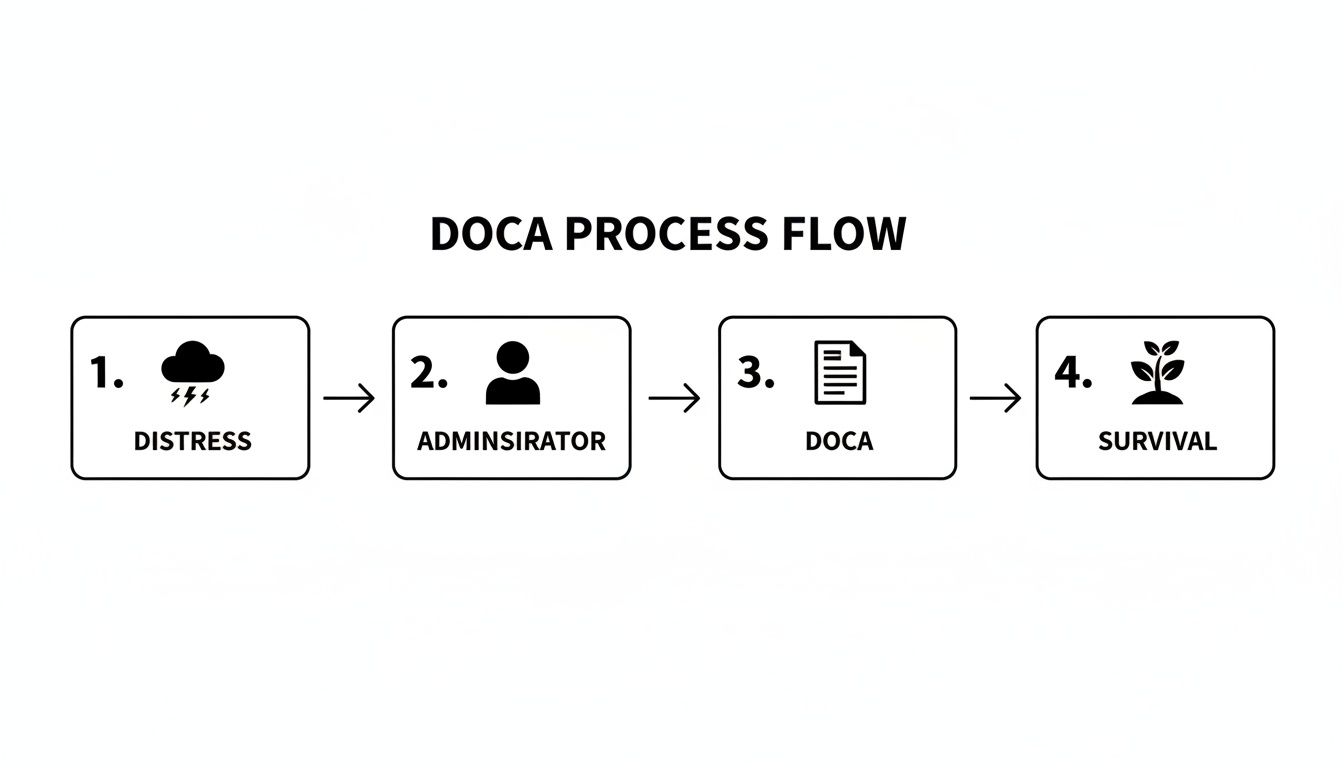
This flowchart maps out the typical journey from financial distress to a successful DOCA.

A flowchart illustrating the Deed of Company Arrangement (DOCA) process, from distress to survival.

As you can see, it’s a structured rescue mission, built to guide a company from crisis towards a genuine shot at survival.

The First Creditors Meeting

Within eight business days of being appointed, the administrator must call the first meeting of creditors. This initial get-together has two main jobs. First, it’s a chance for the administrator to formally introduce themselves and walk everyone through how the voluntary administration process works.

Second, it gives creditors the power to form a committee of inspection. This committee, usually made up of a few of the larger creditors, acts as a sounding board. They can consult with the administrator and get more detailed updates, representing the interests of all creditors throughout the process.

The Administrator's Investigation and Report

After that first meeting, the administrator rolls up their sleeves and conducts a deep dive into the company's business, assets, finances, and general state of affairs. All their findings are bundled into a critical document called the Section 439A report.

This report is the cornerstone of the whole process. It gives creditors everything they need to make a properly informed decision. Inside, they'll find:

  • A summary of the company’s financial history and where it stands now.

  • The administrator's professional opinion on the three possible outcomes for the company.

  • A clear recommendation on which path is in the creditors' best interests.

The administrator has to weigh up three options: end the administration and hand the company back to the directors, approve a Deed of Company Arrangement, or tip the company into liquidation. Their recommendation is based purely on which path is likely to deliver the best financial return to the creditors.

This comprehensive report has to be sent out to all creditors at least five business days before the second, and far more important, creditors' meeting.

The Decisive Second Creditors Meeting

This is it—the moment of truth where the company's fate is sealed. Typically held within 25 to 30 business days of the administrator's appointment, this is where creditors vote on one of the three options laid out in the administrator’s report.

For a DOCA to get the green light, it needs to pass a dual resolution. Think of it as winning two votes at once. A majority of creditors must vote in favour based on both:

  1. Number: More than 50% of the individual creditors present and voting.

  2. Value: The creditors voting 'yes' must represent more than 50% of the total dollar value of the debt owed to those voting.

If the vote is split—say, most creditors in number vote for the DOCA, but the big-money creditors vote against it—the administrator gets a casting vote to break the deadlock. It’s a big responsibility, and any disgruntled creditor can challenge that decision in court. For directors, getting your head around the mechanics of a corporate restructure is vital for preparing for this phase.

If the creditors vote to accept the DOCA, the company and the administrator must sign the deed, usually within 15 business days. Once that ink is dry, the voluntary administration ends, the DOCA officially kicks in, and it becomes binding on all unsecured creditors. But if the proposal gets voted down, the company usually slides straight into liquidation.

How a DOCA Legally Affects Your Business and Creditors

Signing a Deed of Company Arrangement is a pivotal moment for a company in trouble. This isn't just another piece of paper; it’s a legally binding agreement that completely rewrites the rules of engagement for your company, its directors, and everyone you owe money to. It effectively draws a line in the sand, moving the situation from a chaotic scramble for payments to a structured, legally protected recovery plan.

The most immediate and powerful effect is what’s called a moratorium—a complete freeze on most creditor actions. Once the DOCA is signed, it binds all your company’s unsecured creditors. This means suppliers, contractors, landlords, and even the Australian Taxation Office (ATO) for certain debts are legally stopped from chasing the company for money owed before the administrator was appointed.

This legal shield holds firm even for creditors who voted against the DOCA. Their claims are now handled strictly under the terms of the deed, and they can't take separate legal action like issuing a statutory demand or trying to wind up your company. It’s a powerful tool that creates the breathing room needed to actually focus on a rebuild.

Hands exchanging and signing a legally binding document on a wooden desk with a laptop and phone.

Unsecured Creditors Versus Secured Creditors

It’s absolutely vital to understand that a DOCA doesn't treat all creditors the same. While it forces the hand of unsecured creditors, the story is quite different for those holding security over the company's assets.

A secured creditor—think a bank with a charge over your property or equipment—generally isn't bound by the DOCA unless they specifically consent to be. They can often still enforce their security and repossess the asset. Having said that, many secured creditors will choose to support a DOCA if they believe a trading business gives them a better chance of getting their money back than a fire sale in a liquidation.

Employee entitlements get special treatment, too. The Corporations Act 2001 is very clear: a DOCA must ensure that things like unpaid wages, super, and leave are paid in full before other unsecured creditors see a cent, unless the employees themselves agree to a different deal.

The Commercial Reality After Signing

Legal jargon aside, a DOCA triggers huge commercial changes, most of which are aimed at getting the business back on its feet. Perhaps the most important shift is that control is returned to you.

Once the deed is executed, the company is handed back to the directors to manage day-to-day operations. You are back in the driver's seat, but you must steer the company according to the roadmap laid out in the DOCA's terms.

This return of control is a massive advantage over liquidation. It means you can:

  • Continue Trading: The business can keep its doors open, serve customers, and bring in revenue, which is often crucial for funding the payments under the DOCA.

  • Preserve Relationships: You get a chance to salvage relationships with key suppliers and customers, protecting the company’s hard-won goodwill and market standing.

  • Retain Key Staff: A DOCA allows you to keep your experienced team, and their skills are often the critical ingredient for a successful recovery.

This continuity is invaluable. It protects the brand you've built and sidesteps the destructive finality of a liquidation.

Implications for Company Directors

For directors personally, a successful DOCA can be a massive relief. One of the biggest fears for directors of a struggling company is an insolvent trading claim, where they can be held personally liable for debts racked up while the company couldn't pay its bills.

After a DOCA as been signed and as long as all terms are complied with, a voluntary administrator is not able to make directors personally lianle for the debts of the company through an insolvent trading claim. This protection is a powerful incentive for directors to act early and put forward a real turnaround plan—it’s a pathway to not only saving the business but also protecting their own financial position.

If the directors has been issued with a lockdown Director Penalty Notice ('DPN') from the ATO, a DOCA will not release the directors from personal liability of the DPN. The ATO may accept the DOCA and once the DOCA as been effectuated or finalised, the ATO may collect their remaining debt from all the directors persoally. If a non-lockdown DPN has been issued by the ATO, directors may avoid personal liability by placing the c ompany into Voluntary Administration within 21 days of the date of the DPN.

Choosing Between a DOCA and Liquidation

When a company hits the financial skids, directors are left staring down one of the toughest decisions they’ll ever make. It’s a fork in the road with two very different destinations: push for a Deed of Company Arrangement (DOCA), or accept the finality of liquidation. This isn’t just a numbers game; it's a strategic call that will dictate whether the business has a future.

Making that call means getting brutally honest about what each path entails.

Think of liquidation as the end of the line. It's a terminal process where the company’s story is over. The main job is to shut everything down, sell off the assets for whatever they can fetch, and give whatever’s left to creditors. A liquidator takes the keys, and the business as you know it is gone for good.

A DOCA, on the other hand, is a lifeline. It’s a structured rescue mission. The goal here isn't to close the book, but to write a new chapter. It's a legally binding deal designed to save the company or, at the very least, get a much better result for creditors than a liquidation fire sale ever could.

A bronze justice scale with 'CHOOSE YOUR PATH' sign, folders, a plant, and documents on a desk.

A Head-to-Head Comparison

To really get your head around the two options, you need to see them side-by-side. The consequences for everyone involved—directors, staff, and creditors—couldn't be more different.

This table cuts straight to the chase, comparing the things that truly matter when you're weighing up a DOCA against liquidation.

Comparing Key Outcomes: DOCA vs Liquidation

Factor Deed of Company Arrangement (DOCA) Liquidation
Business Survival Higher Potential. The entire point is to get the company trading again and back on its feet. Zero. The business is shut down permanently, and the company is eventually deregistered.
Director Control Returns to Directors. Once the DOCA is signed, control usually reverts to the directors to run the business under the new terms. Lost Completely. A liquidator steps in and takes full control to wind up the company's affairs.
Employee Outcomes Jobs Preserved. If the business keeps trading, employees usually keep their jobs. Jobs Lost. All employment contracts are terminated as soon as the business stops operating.
Creditor Returns Often Higher. Creditors almost always get a better return (more cents in the dollar) from a going concern than from asset sales. Often Very Low or Zero. Unsecured creditors are at the back of the queue and frequently end up with nothing.
Personal Liability Potential Relief. Can be a shield for directors against insolvent trading claims and help manage ATO Director Penalty Notices, if a non-lockdown DPN was issued and an appointment is made in time. High Risk. The liquidator is required to investigate for insolvent trading, which can lead to directors being held personally liable for company debts.

It's clear that from a survival and continuity perspective, the two paths lead to vastly different places. The DOCA is about rebuilding, while liquidation is about dismantling.

Why a DOCA Often Delivers a Better Outcome

The numbers don't lie. For creditors, liquidation is often a dead end. ASIC data shows that in a shocking 80% of insolvencies, unsecured creditors get absolutely nothing back. Not a cent. It’s a grim reality for suppliers who have extended credit in good faith. This is where a DOCA really shines, offering a structured path to a better return while keeping a viable business alive and people in jobs. You can find more insolvency statistics in this comprehensive report.

For directors, getting expert pre-insolvency advice on a DOCA isn't just about saving the business. It’s a crucial step in protecting their own personal financial position from things like Director Penalty Notices.

Understanding the Liquidator's Role

In a liquidation, the liquidator's mindset is completely different from an administrator's. Their legal duty is to the creditors, full stop. Their job isn’t to save the company; it’s to look backwards and investigate what went wrong.

A liquidator is required by law to investigate the company's affairs for any potential recovery actions. This includes scrutinising transactions for unfair preferences, uncommercial transactions, and, most critically, pursuing directors personally for insolvent trading.

This investigative power is probably the single biggest risk for directors facing liquidation. A DOCA, by contrast, is forward-looking. When creditors vote to approve it, the deal can include a release from those very claims, giving directors a shield that liquidation simply can't offer. You can learn more about what is the true role of a liquidator in our detailed guide.

Ultimately, the choice between a DOCA and liquidation boils down to one question: is there a viable business here worth saving? If the core business is sound but has been sideswiped by bad debt or a market downturn, a DOCA provides a way back. If the business is fundamentally broken, liquidation might be the only option left on the table.

Common DOCA Challenges and Recent Legal Trends

Getting a Deed of Company Arrangement over the line with creditors is a huge step, but it’s definitely not the end of the story. A DOCA isn't a magic wand for your company's problems; it's a fragile agreement that can run into serious trouble, sometimes even getting torn up by the courts. If you're a director thinking about proposing one, you need to know what can go wrong.

The most common reason a DOCA falls apart is painfully simple: the company can't hold up its end of the bargain. If you miss the scheduled payments into the creditor fund or breach another important part of the deal, the Deed Administrator's hands may become tied. They'll likely have to terminate the DOCA, and that usually means the company tumbles straight into liquidation.

But the challenges can start much, much earlier. A DOCA can be legally challenged and thrown out if it's seen as unfairly prejudicial to a particular creditor or group of creditors. This is where the fairness and real-world viability of your proposal get put under a microscope.

The Courts and the Tax Office Are Watching Closely

Over the last few years, Australian courts have stopped rubber-stamping DOCAs. They're taking a much harder look at the terms and are more willing than ever to terminate deals that don't feel right, even if they technically scraped through a creditor vote. This is especially true if the DOCA looks like it's designed to benefit directors or related parties at the expense of everyday, arms-length creditors.

Revenue authorities, particularly the Australian Taxation Office (ATO), have become a major force in this space. They are aggressively challenging DOCAs they believe are unfair, and it’s not hard to see why.

The big lesson from recent court cases is this: a DOCA has to be more than just a slightly better deal than liquidation. It must be genuinely fair and not crush any single group of creditors. A plan that only wins on a technicality, without real commercial backing from the majority of creditors by value, is living on borrowed time.

For example, courts have recently thrown out DOCAs where:

  • The DOCA only was approved by related paries: A large creditor forced the vote through, ignoring the wishes of dozens of smaller, independent businesses.

  • The offer was insulting: The dividend proposed for creditors was so tiny it wasn't seen as a genuine compromise.

  • Creditors were kept in the dark: The administrator didn't provide enough information for creditors to make a properly informed decision about the company's future.

Why Your Proposal Has to Be Rock-Solid

All these legal trends point to one critical fact: your DOCA proposal needs to be robust, commercially realistic, and completely transparent. It's no longer enough to just offer creditors a few more cents in the dollar than they'd get from a liquidation fire sale.

A proposal that works needs meticulous planning and a brutally honest look at whether the company can actually trade its way back to health. This is exactly why getting expert pre-insolvency advice isn't just a good idea; it's essential. An experienced advisor can help you see around corners, anticipate objections from creditors like the ATO, pressure-test your forecasts, and build a DOCA that is fair, achievable, and can stand up in court. Getting it right from the beginning massively boosts your chances of pulling off a successful restructure and giving your company a real future.

When to Get an Expert on Your Side for a Deed of Company Arrangement

Getting your head around what a Deed of Company Arrangement is and how it stacks up against liquidation is a great first step. But let's be clear: navigating this legal minefield isn't something you should ever attempt on your own. Deciding to go down the DOCA path needs careful, proactive planning and specialised advice from the very first hint of financial trouble.

Waiting for a full-blown crisis before calling for help is one of the most common—and expensive—mistakes directors make. Getting a pre-insolvency advisor on board early can honestly be the difference between a successful restructure and a collapse that could have been avoided. The moment you start finding it tough to pay suppliers, you're falling behind on ATO lodgements, or you just feel that constant pressure from mounting debts—that's the time to act.

The Value of a Pre-Insolvency Specialist

A dedicated pre-insolvency advisor, like the team here at LemonAide, plays a completely different role to a voluntary administrator. Our first and only duty is to you, the director, not your creditors. Think of us as your advocate, strategist, and guide through what can be a very daunting process.

Expert pre-insolvency guidance is all about crafting a viable restructuring plan that creditors will actually approve, while simultaneously shielding you from personal liability. It’s about building a rock-solid foundation for a DOCA that not only saves the business but also secures your own financial future.

Bringing in an advisor early gives you a few massive advantages:

  • An Objective Look: We’ll take a hard, unbiased look at your company's financial state to figure out if a DOCA is a realistic and genuinely beneficial path forward.

  • Strategic Game Plan: We help you put together a commercially sensible proposal that gets ahead of creditor concerns, especially from big players like the ATO.

  • Liability Shield: We give you straight-up advice on your director duties, helping you use the insolvency provisions to your advantage and cut down the risk of being held personally liable for insolvent trading.

  • Negotiation Backup: We’re in your corner, helping you frame the proposal in a way that gives it the best possible chance of getting the green light from creditors at that all-important second meeting.

At the end of the day, a Deed of Company Arrangement can be a powerful tool for hitting the reset button financially. By getting expert advice before the situation gets critical, you give yourself the strategy and support you need to restructure successfully, save your business, and move forward with confidence.

Your Burning DOCA Questions, Answered

When you're staring down the barrel of company insolvency, concepts like a Deed of Company Arrangement can throw up a lot of specific, practical questions. It’s completely normal. Let’s cut through the noise and tackle some of the most common queries I hear from directors every day.

Can I Still Run My Business During a DOCA?

Yes, in most cases, you’re back in the driver’s seat. Once the DOCA is officially signed and locked in, control of the company usually flips back to the directors. You're the one managing staff, dealing with customers, and bringing in revenue again.

But it’s not a complete free-for-all. You have to run the business strictly by the rules laid out in the DOCA—it's a legally binding agreement, after all. The deed administrator hangs around in an oversight role, mainly to make sure you're holding up your end of the bargain, like making the agreed-upon payments to creditors.

What Happens to My Personal Guarantees Under a DOCA?

This is a big one, and you absolutely need to get this straight: a DOCA does not wipe out your personal guarantees. Think of the DOCA as a deal between your company and its unsecured creditors. Any creditor who holds your personal guarantee can still come after you, personally, for the debt.

So, if you personally guaranteed that big business loan from the bank, they can still chase your house or personal savings, even while the company is protected. This is exactly why you need advice that looks at the whole picture—your company’s position and your personal financial exposure.

A Deed of Company Arrangement is a corporate fix, not a personal one. It deals with the company's debts. Unless you specifically negotiate a separate settlement, you have to assume your personal guarantees are still live and very much in play.

How Long Does a Deed of Company Arrangement Last?

There’s no set timeframe; it’s not like a prison sentence. The duration of a DOCA is whatever the creditors agree to. It's completely tailored to the proposal on the table.

I've seen DOCAs wrap up in just a few months, especially if the plan involves a simple one-off lump sum payment from a new investor. On the other hand, a DOCA could stretch out for several years if it’s funded by contributions from the company’s future profits. Once every obligation in the deed is met, the DOCA terminates, and you get the company back, free and clear of all the historical debts it covered.

What Is the Success Rate of a DOCA?

Honestly, success comes down to one thing: how realistic the plan is. Plenty of DOCAs get over the line successfully, giving good businesses a second chance to not just survive but really kick on.

But failure is always a possibility. If the company breaks a major term of the deal—and the most common breach is missing a payment—the fallout is swift and severe. The deed administrator will almost certainly terminate the DOCA, and the company will tip straight into liquidation. There’s no second-second chance. That's why putting together a proposal that is genuinely achievable is the most critical part of the entire process.

Is it time to chat?

Figuring out what a Deed of Company Arrangement really is and if it’s the right move for your business requires a guide who's been through the trenches. At LemonAide, we provide clear, strategic advice that considers your unique business and personal situation, making sure the decisions you make today protect you tomorrow. Contact us for a free, no-obligation chat at https://www.lemonaide.com.au.